 Blogcritics The critical lens on today's culture & entertainment

Bus Stop
William Inge’s subtly deep drama Bus Stop at Classic Stage Company sports comedic elements. Presented on Broadway in 1955, the play rarely enjoys a revival. On close inspection, one wonders: Why not? Its themes abide for us today. From loneliness, to suppressed desires, to the desperation for human connection and the need for love, Inge’s play serves as a touchstone for these feelings in its simplicity. Directed by Jack Cummings III in a co-production from NAATCO, Classic Stage Company, and Transport Group, Bus Stop‘s current revival runs until June 8.
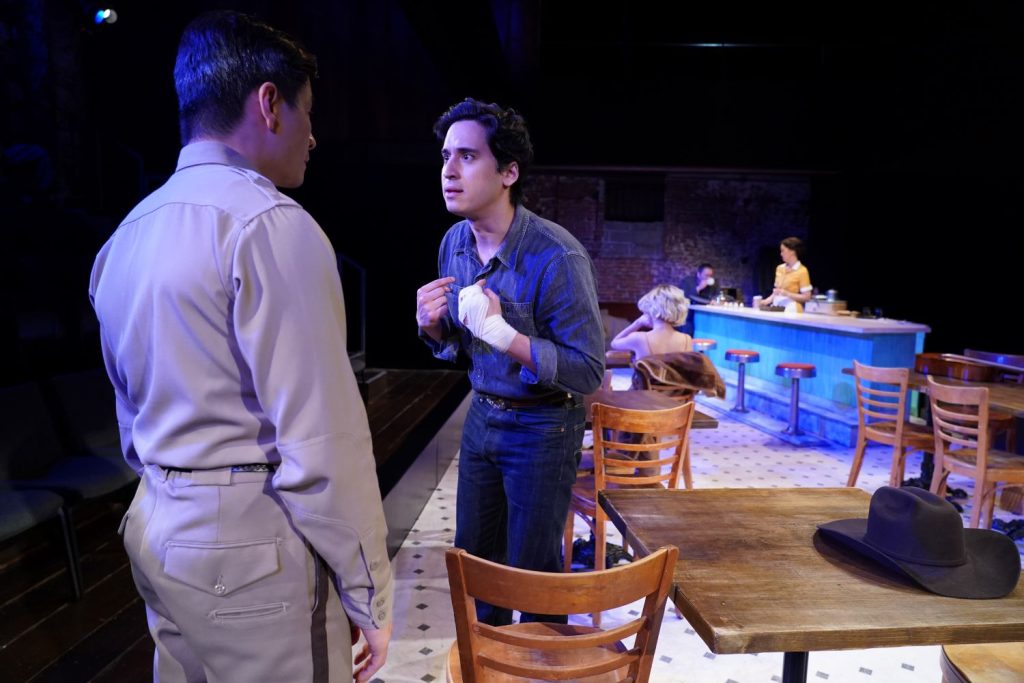
As eight characters are stuck together during a blizzard at a dingy diner, the synergy they create changes some of their lives. Staged with the audience on three sides, the production takes advantage of Peiyi Wong’s spare and minimalist set to create intimacy. The faded blue (teal) counter at a diagonal in the acting space, and the cafe chairs and tables closer to the audience, reflect an Edward Hopper painting. The lighting (R. Lee Kennedy) reveals intimate conversations between the characters, and the costume design (Mariko Oigashi) is period simple.

The Establishing Scene
In an establishing scene Inge presents the innocent Elma (Delpi Borich), a high school student and waitress helping diner owner Grace (Cindy Cheung), whose husband has abandoned her, prepare for the arrival of a bus. These characters represent typical mid-western, parochial types – until we see the undercurrents stirred up by the bus passengers and bus driver Carl (David Shih).
After the setup the real action begins with entrances that provoke further interchanges. First, sheriff Will (David Lee Huynh) forecasts road closures and a storm behaving as if the elements had “lost their reason.” Interestingly, Cummings foregoes any stormy sound effects (indeed there is no sound designer credited). Instead, he relies on the actors to evoke the snow, cold, and wind in their reactions and dialogue. Cummings may have done this to symbolize the interior storms in the characters’ lives. But the effect is that the silence of the supposed cause for these characters to meet in this particular diner underwhelms.
The next character to enter, Professor Dr. Gerald Lyman (Rajesh Bose), eventually makes a beeline for the fresh-faced, naive Elma. His poetic language suggests his literary accomplishments and sophistication, which fascinate her and draw her in. Clearly, no one like him has ever given her such attention, and she little suspects an arrangement he makes with her to meet outside the diner to be insidious.
The Main Characters
Next, Cherie (Midori Francis) comes exploding into the diner. The young, blonde, uneducated nightclub singer begs for a place to “hide” from a “man.” As she runs to the powder room, Grace tells her the cold will freeze her. We, and Cherie, realize the backwards nature of an outside toilet, one step above an outhouse. We understand that these characters are struggling, one rung above poverty.
As Sheriff Will pries the circumstances out of an excited, inarticulate Cherie, we discover that cowboy Bo (Michael Hsu Rosen) has “kidnapped” her to take her to his Montana ranch against her will. Apparently Bo, with his companion, ranch-hand Virgil (Moses Villarama), saw Cherie singing in a club and Cupid’s arrow struck him. However, it takes much push and pull, rejection, fisticuffs, and final soulful revelations by both Bo and Cherie for them to understand they have fallen fast and hard for each other.

The Main Action
Cherie and Bo’s sturm und drang finally blossoms into understanding and care, solidifying the play’s major action. The other characters, especially Virgil and Will, add their wisdom and attempt to create peace between the two. Between the dramatic moments, the humor and intimacy flows among Grace, Carl, Elma, and the professor as they follow their own agendas.
Carl and Grace establish a budding relationship because the storm allows them the time to become involved intimately. Also, the professor, who gets drunk, continues to encourage Elma’s interest. Her lovely innocence and concern for the older man overwhelms any nefarious intentions he may have had towards her. Inge uses these two characters to manifest the theme of goodness overcoming evil.
Deep Humanity
As the play develops it reveals the depth of the characters’ humanity. He makes the unlikable Bo and Cherie vulnerable and likable once they reveal the heart of their personal truths. This drives home the point that if one sits down and breaks bread with someone who appears to be on the opposite side of some issues, oftentimes agreement can be reached. Inge, with a complexity that appears simpler than it is, provides relevant backstories for Bo and Cherie that elucidate why they end up together.
The Performances
Some of the performances resonate with power, others less so. Midori gives us a striking look at a gal from the Ozarks struggling to make a place for herself, then realizing that Bo offers her a world that shines in comparison to the tawdry life she’s led.
Virgil, who sacrifices his happiness and perhaps love for Bo, as he allows him to create a life with Cherie, expresses a haunting sadness and isolation. Virgil allows the audience to see his grief at giving up Bo to Cherie, even as both Cherie and Bo chide Virgil for not coming with them to Montana. The grief, which he keeps to himself, reveals, in an interesting interpretation of the character, that his concern for Bo may be more than just that of a friend. Indeed, we wonder if Virgil has another job to go to as he says, or just lies to disentangle himself gracefully from an unrequitable love.

Intimacy of Setting
In the intimate setting cataclysms occur. In response to Elma’s kindness, the professor suggests he may seek the therapy that friends have suggested. Grace admits her humanity to Elma, saying apologetically that she sometimes “needs a man.” Elma feels wanted and desired when she hears that the professor’s interest in underage girls makes him untoward and perverse – she refuses to see him that way. Because her innocence made him retreat, she bestows a kind of grace upon him so that perhaps he will seek help finally.
In Inge’s humble diner, lonely, isolated and desperate people arrive, then leave uplifted and gently redeemed from themselves. Cummings’s direction captures this depth of the “everyperson” with poignance, a tear and a smile.