 Blogcritics The critical lens on today's culture & entertainment
NOTE: No spoilers here.
“After years of war, no one could stand between my men and home. Not even the gods.”
Sir Christopher Nolan continues his masterful filmmaking with The Odyssey, his 13th feature film, and second consecutive with Universal Studios. Nolan directed this mighty film, wrote the screenplay, and also co-produced with his wife Emma Thomas.
The Odyssey is the first feature film to be completely shot on IMAX 70mm film cameras and the first feature film in history to have a pre-sale one year in advance.
Based on Homer’s classic Greek epic poem, The Odyssey is set during “a time of apparent magic.” The talented cast depict important figures and Greek gods.
The original work is not required reading before seeing this film, but it would enhance the experience to have advance knowledge of the story’s elements (e.g., the rules of “Zeus’ hospitality,” burial traditions).
A More Than Worthy Cast
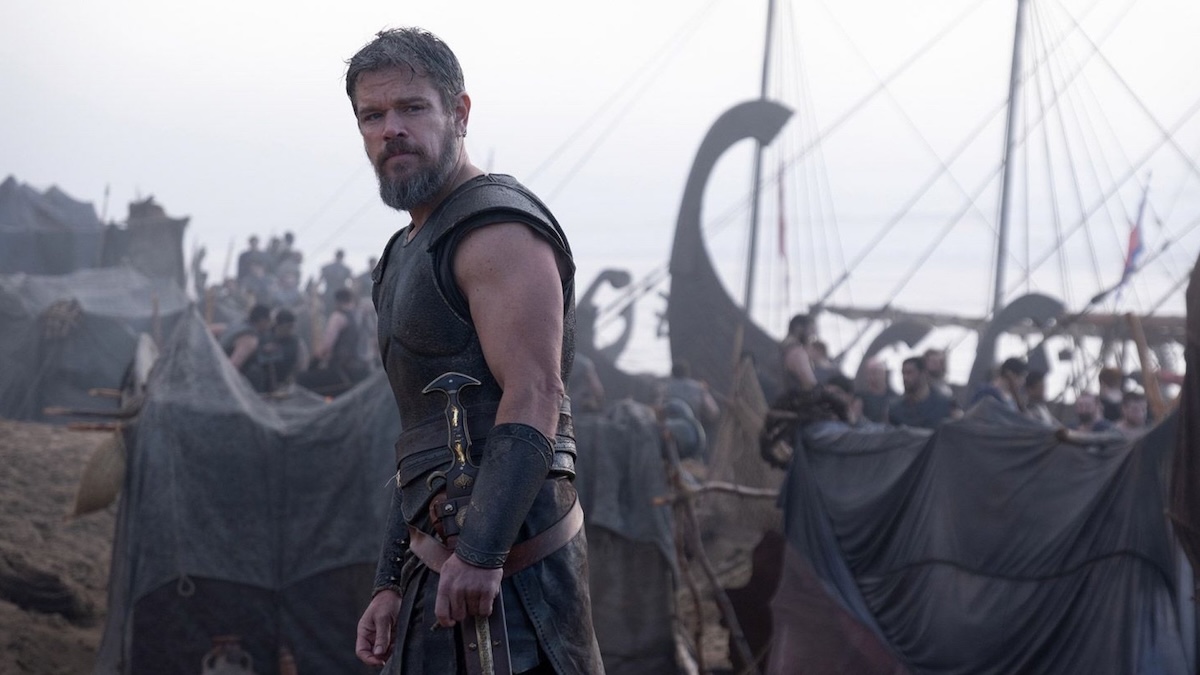
These adventures of Odysseus, the Greek king of Ithaca (Matt Damon), occur after the Trojan War depicted in Homer’s The Iliad.
Like Odysseus and his shipmates, the cast and crew endured incredible challenges throughout the film, especially in the sailing sequences, which put the audience directly in the boat with the characters.
Many elements mirror the Bible, including the “Golden Rule,” plus common tropes like “God helps those who help themselves” which actually does not appear in the Bible. Other mirrored moments include Odysseus’ “leap of faith” moment.
Since we’re talking gods here, The Odyssey definitely has a Biblical-epic aura. It tells the classic story in modern English with one of the best casts ever assembled (the casting director was John Papsidera). They serve the story incredibly well. No one is showboating or chewing the scenery. Their authentic performances inject the audience directly into this epic world where the action-filled conflicts supplement the memorable dialogue.
Odysseus’ wife Penelope (Anne Hathaway) must use all her wits to retain the Ithacan kingdom as Odysseus treks his way home. Their son Telemachus (Tom Holland) also features prominently, as he must also endure and overcome several extraordinary situations.
All the characters have immense, well…character in this ancient world. Damon is perfectly cast as the lead. Odysseus’ intellect, physicality, and emotional intelligence save his skin as his talents also create the plot’s central conflict.
Odysseus learns a lot on his journey. He wisely seeks and takes advice. He exercises key strategies with honor, faith, and righteousness. Damon consistently enlivens the action-packed story, especially when Odysseus uses powerful strategies to protect his crew in their seemingly endless adventures.
Hathaway gets real depth beyond the loyal wife awaiting her husband’s return. Her immense intellect equals Odysseus’, especially in the climax at the end of the two hour and 52-minute story.
Telemachus’ direct involvement and predictable actions serve the story well as Holland shines in a stellar performance, which should likely end his time portraying younger characters. Ryan Hurst (Sons of Anarchy series, Saving Private Ryan) needs to be in a lead role after his magnetic portrayal of Telemachus’ battle trainer/bodyguard.
Robert Pattinson impresses as the main antagonist, Antinous, one of the many arrogant and sleazy suitors who seek Penelope’s hand in marriage to get the kingdom. His logic is sound but his corrupt heart fails him as he ultimately buckles under the moral weight and admirable strength of the protagonists. Pattinson should see several acting award nominations, as should Damon. Corey Hawkins portrays another suitor, Polybus..
The cast also includes Charlize Theron as the nymph Calypso, Samantha Morton (Minority Report) as Circe, Zendaya as the goddess Athena, and Lupita Nyong’o (Black Panther, 12 Years a Slave) as Helen of Troy, who sacrifices some screen time to serve the story. But few of these female roles are expansive.
John Leguizamo gives a powerful portrayal of faithful Ithacan servant Eumaeus, constantly ridiculed – and underestimated. Mia Goth portrays Odysseus and Penelope’s maidservant while Logan Marshall-Green portrays the servant Melanthius.
Himesh Patel plays Odysseus’s second-in-command Eurylochus. Portraying other shipmates are Will Yun Lee, Jimmy Gonzales, and Andrew Howard. Elliot Page (Inception) is Sinon, a key character in the Trojan War.
Benny Safdie gets the prominent role of Agamemnon, who is likely the biggest learning curve for viewers who don’t know the source material. He is the Greek king of Mycenae, Clytemnestra’s husband, Menelaus’s brother, and the commander of the Achaeans during the Trojan War.
Bill Irwin (Interstellar) provides a base portrayal of the Cyclops Polyphemus (also incorporating an animatronic puppet) that memorizes viewers while providing a vital turning point in Odysseus’ personal journey.
The well-cast James Remar (48 Hours, Django Unchained, Sex and the City series) maximizes his unique vocal talents in his short but memorable portrayal of the blind prophet Tiresias.
A Stellar Crew
After a wonderful beginning with a bard (rapper Travis Scott) who sets the tone of this historic oral poetry, Nolan and his incredible crew prove yet again that they’re among the best in the business.
The continuity editing from Jennifer Lame keeps the audience in a steady flow with no fades. No text or explanations of the time jumps are provided yet the audience is not overtaxed or stressed. Simultaneous sequences (e.g., the Aeaea island sequence) are well-executed gems that bring constant satisfaction.
The high frequency of practical effects wisely puts the story at the highest priority instead of just shooting then adding visuals later in post-production. This production approach costs more money (reportedly approximately $250 million) to meet the high standards that thankfully lead to high results.
With the incorporation of modern English, Nolan solves one of the biggest complaints about his films: some audiences’ difficulty understanding the dialogue. Nolan adapted the dialogue to today’s culture to help the audience understand it. It’s a win-win for the filmmakers and the audience.
The cinematography (Nolan mainstay Hoyte van Hoytema) and booming sound reach new high standards. These two elements play huge parts in this immersive experience where the dialogue and characters’ reactions set the tone for each event.
For example, the siren sequence is pre-empted by Odysseus not only convincing his crew to take precautions but sacrificing his own comfort to warn his crew. The filmmakers drop out the sound to great effect as Odysseus endures the “song of all the promises I failed to keep.”
The groundbreaking redesign of the next-generation Keighley IMAX cameras that allowed the crew to film at a higher efficiency and quality will hopefully put future filmmakers on Nolan’s trailblazing path.
The musical score from Ludwig Göransson features no orchestra. Instead, the musicians play recreated Greek instruments of the time, like the aulos, bronze gongs, and lyre. Vocals provide the stable foundation usually reserved for orchestral string sections. (The score will be released digitally on July 17, on vinyl on July 31, and on compact disc in August).
The set (Larry Dias and Gene Serdena), costumes (Ellen Mirojnick), production design (Ruth De Jong), and hair and makeup (Gloria Casney) using no wigs are all excellent.
The producers also often incorporated local crew members from each international filming location, which included Greece, Iceland, Malta, Morocco, Scotland, and Sicily.
The Odyssey is highly recommended (**** out of four stars) and rated R for violence and some language. See it in IMAX theaters if possible, or the biggest theater available.