 Blogcritics The critical lens on today's culture & entertainment
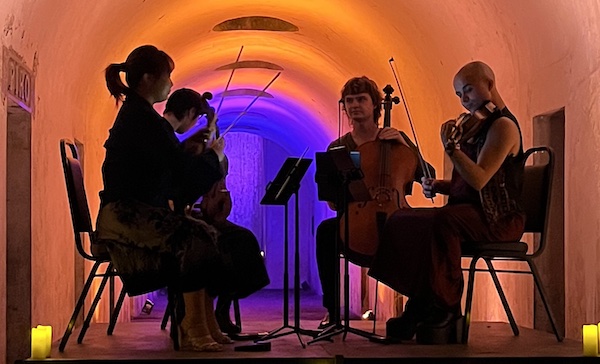
Train after train bypassed the 25th Street station and I grew more and more frustrated. It was late and my wife and I needed to get home and get some sleep. Reports were that someone had pulled an emergency brake on a train a few stations ahead and an investigation was underway. After many minutes, some newcomers pushed through the turnstiles, trundling instruments: The musicians of the Poiesis Quartet were joining us audience members on the subway platform, having wrapped up the second of their two concerts of the evening at the Green-Wood Cemetery catacombs.
They were young, just a handful of years out of Oberlin Conservatory. Still, amped-up as they seemed, they must have been at least as tired as we were. Suddenly, I felt a bit better.
Tunnel of Destiny
Twice that evening the Quartet had artfully tempered their touch to the acoustics of the long, narrow catacombs – really just one straight tunnel with alcoves along the sides. More so than a grand piano, which can overwhelm the space, the instruments of the violin family can be addressed with almost infinite degrees of gentleness and aggressiveness. These musicians had clearly thought out how they were going to approach two challenging works: Beethoven’s final string quartet, the Op. 135 with its famous Must it be? It must be themes; and the New York premiere of Tapestry of the Beloved Beatified by Jeff Scott at the latest Death of Classical event.
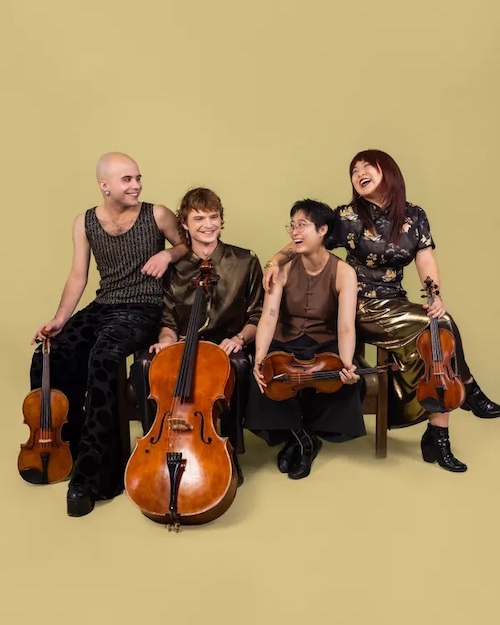
Subtlety in phrasing and dynamics clarified the humor and spirit of the first movement of the Beethoven. The musicians seemed to breathe together in their phrasemaking, including just-right rubatos and pauses. Volume was high at times, but not at the expense of limpidity and nuance.
The second movement with its disconcerting off-rhythms emerged spiky and brawny in a rendition that impressed me just as much. The energy felt electrical and palpable.
The slow movement provided a response and a respite; it read like a prayer as the musicians leaned into Beethoven’s meaning-choked harmonic motion, rendering it somehow both tragic and comforting. Hearing this ineffable music played so beautifully in such an intimate space is something not quite describable in words.
The finale’s swirl of resignation and hope capped a performance that persuaded me that the Poiesis Quartet is one of the finest young chamber ensembles on the scene. It’s easy to make such a statement – there are many superb young musicians and groups lighting up our classical and contemporary music scene, despite the many challenges of an artist’s life. But I’m convinced it’s no hyperbole in this case.
Four Saints in Four Acts
The players showed equal enthusiasm and skill with the new music from Jeff Scott. With his fascinating Tapestry of the Beloved Beatified, composer and French hornist Scott advocates a secular “canonization” of four LGBTQ+ activists, three of whom met ends that could be called martyrdom.
I’ll admit right off that at some points during the work I lost track of where one movement ended and the next began, but this was, I think, less because of imperfect attention and more because the music contains many elements and gripped me in a multitude of ways.
The first movement honors Harvey Milk. I’ve lived long enough that it’s hard for me to absorb the reality that today’s younger generations have to learn who he was – Sean Penn played him in a movie, no less! Scott opens the movement, and the suite, with a frenzied barrage of sound that to me suggested the San Francisco political crusader’s violent end. Then, flowering out of the rough, came mournful harmonies recalling Renaissance music – so already Scott is bridging modernist and ancient traditions.

Further into the suite we hear a long – maybe a little too long – sequence of soft, high harmonies in the violins. Viola and cello enter underneath, keening loudly. The introduction of spoken words (intoned by the musicians), in the form of chants from (I think) a Latin Mass, creates surprise and grabs attention as it transports us into a world of indeterminate time.
The work progresses through movements honoring murdered Bangladeshi activist Xulhaz Mannan, PFLAG co-founder Jeanne Manford, and trans activist Marsha P. Johnson, the “Saint of Christopher Street.” Grieving chords and pained groaning are, I think, meant to make sure we remember the tragedy and troubles they and many others have endured in the struggle for the still-fragile LGBTQ+ rights that some of the world’s nations have hesitantly adopted and even in some cases enshrined.
But Scott also writes double-stop passages reminiscent of Anglo-Appalachian folk music, and strains that seem to come from eastern or Middle Eastern folk traditions. Elsewhere, swirling figures rise to stormy heights. Pizzicatos unite like a toy choir. The cello solos majestically in its high range. Spoken words reappear. Muscular rhythmic passages feature polyrhythms that nod to Africa, Western modernism, or both.
Now and again, I felt a softening of focus in some of the drama, but the performances never flagged. The Poiesis Quartet sustained the fervid virtuosity they had established in the Beethoven, while showing mastery of extended techniques and the inspired sensibilities of a versatile contemporary composer like Scott.
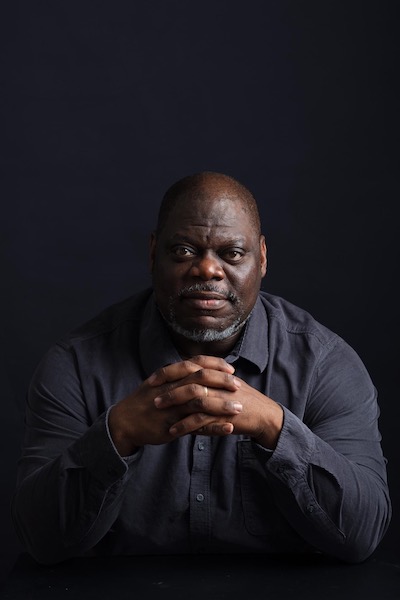
Jeff Scott told me in a recent interview that his intent was to create “a musical ritual spacious enough for [the activists’] courage, vulnerability, and spiritual resonance to be felt, and to honor that courage with the ultimate in spirituality.” I imagine Beethoven would have understood the sentiment. And what better place than the catacombs to experience Beethoven’s last statement – and to discover Scott’s canonization of some who gave their all?
The Poiesis musicians are based in the Midwest. They may not have known as they descended into another tunnel – the subway cavern under Brooklyn’s Fourth Avenue – that not far away, New York State recently named a state park in Brooklyn for Marsha P. Johnson.
Visit the Death of Classical website for more events at the catacombs and other nontraditional venues in New York City and elsewhere. The Poiesis Quartet’s upcoming schedule is online too; if they’re anywhere in your vicinity, do catch them.