 Blogcritics The critical lens on today's culture & entertainment

Cult of Love
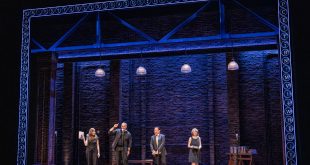
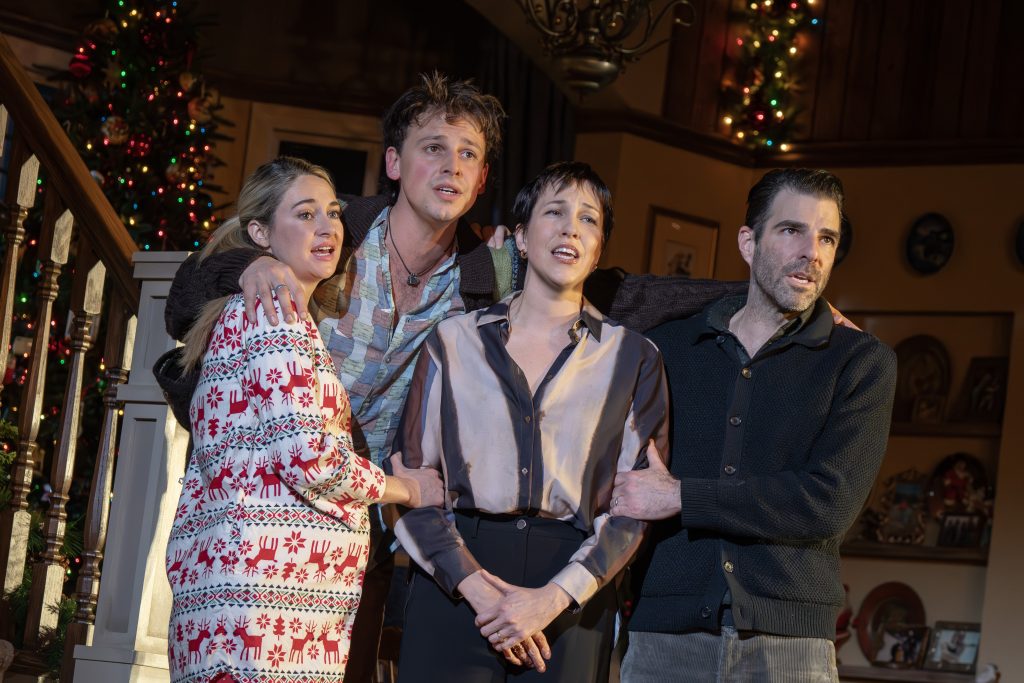
The Dahl family Christmas festivities initially seduce one’s emotions in the exquisitely acted and directed Cult of Love, currently at the Helen Hayes Theater until February 2, 2025. Drawn in by the riotous one-liners delivered with perfection by a sterling cast, the harmonious singing, and the “picture-perfect” seasonally festive sparkling lights and decorations, one thinks obviously this family “has it all.”
Not exactly. We gradually discover the sub rosa wounds after the splendid actors enter. Dad Bill (David Rasche) plays the piano, Mom Ginny (the inimitable Mare Winningham) accompanies him on guitar, and the Dahls sing the first carol of the evening. As they meld harmonies at the top of their lungs, they shock us with their love, joy and happiness. What family sings like this at Christmas?
Apparently, a devoutly Christian family, who, during the course of the sardonically merry evening, reveals the impact of their Christianity. Among them sings an evicted priest, a mentally disturbed prophetess, a few atheists, a very forgetful father, and a resolute, calmly intractable mother (Winningham). Later, a son recovering from an addiction joins them. Ironically, mother hen Ginny, in extreme denial about all of the “issues” with her brood, happily presides over the “celebrations” as hostess. This upsets her children.

Cult of Love’s Individualistic, Flawed Characters Resonate
Directed by Trip Cullman, with superb, brisk pacing that integrates the music with playwright Lesyle Headland’s overlapping, humorously sardonic dialogue, the flawed characters profoundly resonate with us. Their riotousness, as well as their pain, fear and yearnings, make us feel at home. What’s not to love?
The title forewarns us. The family’s love not only harms, it sucks in its members and binds them in chains. Its comfort nurtures immaturity, not growth, The weakened adult children cannot make a place for themselves in the wider culture. Nor can they thrive with autonomy, despite their struggles to do so. We realize, the family love cripples, the more the parents and siblings give it with abundance. For eventually, cruel, biased judgmental comments or dismissals snatch the love away, as the cavernous hurts reopen and bleed afresh.
Music Purposely Weaves Throughout
Headland’s hybrid, sardonic play employs hymnals to underscore the family’s religious hypocrisy, confusion and complication. At turning points of tension or stress, the family breaks into song (i.e. “A Soalin”), to run from acknowledging or talking about difficulties. Throughout, they beautifully harmonize various Christmas-themed songs. Also, after Johnny arrives and they finally sit down to dinner, Bill reminisces about their yearly visits to the Shenandoah Valley, when the children were young. In describing the “perfection” of those sweet moments, Bill nostalgically sings a bit of “Oh Shenandoah,” which also threads in poignantly at the conclusion. Impressively, family members play one, two, or three instruments, unobtrusively scattered about the homey, twinkling living room. I counted 13; there may have been more.
We understand that perfection yearned for rarely emerges with the Dahls. Only in their singing can they achieve unity, inner solace and transient reconciliation.
In stark contrast to these delightful, lively moments of happiness, conflicts erupt like sea monsters, then submerge again. Gradually, the four siblings and their partners disclose their particular traumas and unresolved issues. Zachary Quinto’s displaced, alienated Mark prepared for the seminary. At the last minute he disappointed the family, shifted, went to law school, turned lawyer, but has no job, disappointing wife Rachel. Spiritually lost, he and Rachel (Molly Bernard), who converted from Judaism and never felt accepted by the Dahls, may divorce. Driven to leave early by the youngest sibling “prophetess,” Diana (Shailene Woodley), Rachel gets humorously drunk to deal with the craziness.

Comments and Prayers
Likewise aggrieved by Diana’s insensitive, judgmental comments, sister Evie (Rebecca Henderson), and her newly pregnant partner Pippa (Roberta Colindrez), feel unaccepted for their queer lifestyle. When they challenge the homophobia, those offended “doth protest too much” and profess love. However, Pippa’s pregnancy “disgusts” the anointed Diana, also pregnant with her second child. In support of wife Diana, her former pastor husband James (Christopher Lowell) sweetly oozes censure typically found in conservative Christian fundamentalists.
For moral support to confront his family, Christopher Sears’ Johnny asks Loren (Barbie Ferreira) to join him. Ironically, though Loren is continuing to recover from a near lifetime of addiction, her fearless honesty with the extremists of the Dahl “love cult” (James and Diana) refreshes. An admitted atheist, she explains why she doesn’t believe in God, using gravity as the analogue.
Naturally, her explanation prompts Diana and James to proselytize to Loren and the others. The responses they receive, some furious, some ironic, ultimately strike sparks and hard rancor. Of course, this prompts more singing which ultimately fails to resolve or mitigate the situation. Instead, Diana’s gift of prophecy takes over and the dangerous state of her psychological illness manifests.
Full Throttle
The situation finally explodes. How the siblings unite to handle Diana’s violence speaks to years of dealing with her mental state. Meanwhile, James denies his wife’s illness despite her causing the loss of his church because of her prophecies. Bill encourages the siblings to love one another, though forgiveness and understanding doesn’t come into it. Headland underscores that without forgiveness and understanding, love loses its power. Finally, Winningham’s Mom dismisses the chaos to return them to a “steady state.” When pressed, she excuses Diana’s illness as Diana’s pregnancy. Once more sweeping issues under the rug, Ginny’s “center” holds. Meanwhile, she sets off whirlwinds for everyone else in the family.

The Family Photograph
Rejecting mom Ginny’s adjuration to keep tradition in the Dahl Christmas by taking a family photograph of their festive joy, Rachel, Loren, Evie and Pippa leave in protest. Disappointed, Mom plays it close to the vest. Without yelling, indeed she never yells, she serenely relies on her own unique “magic” to bring them back in the morning for the photograph. She hopes that they won’t break with tradition. The outer appearance of love and unity in a Christmas photograph is her moral imperative.
At this juncture once more we experience shock, this time at the unresolved situation that plays with humor and tragedy. How the characters proceed is something you must experience.
Headland’s brilliant play focuses on the traditions of family, love and celebration, while showing the truths that run counter to the outward, showy displays that accompany them. Unlike typical “home for the holidays” reunion stories, Cult of Love focuses on religiosity, its dangerous misuse, and the confusion in its application. With the exceptional ensemble’s near perfect acting, and Trip Cullman’s expert guidance, Cult of Love is a seasonal hit for any time of year.
Kudos to the excellent work of the creative team which includes John Lee Beatty (scenic design), Sophia Choi (costume design), Heather Gilbert (lighting design), Darron L West (sound design), Liz Printz (hair & makeup design), and Jacinth Greywoode (music supervisor).
Cult of Love runs one hour 45 minutes with no intermission at the Helen Hayes Theater on 44th St. between 7th and 8th avenues until February 02, 2025. Don’t miss it.