 Blogcritics The critical lens on today's culture & entertainment
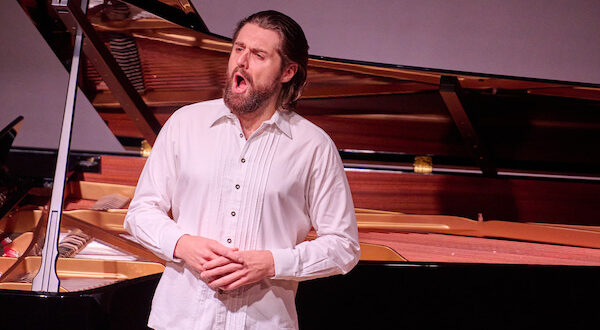
I’ve enjoyed baritone Konstantin Krimmel’s recordings so much that I jumped at the chance to hear him sing Schubert live. His recital with pianist Ammiel Bushakevitz at The 92nd Street Y, New York on December 3 proved that his refined, plastic technique and impressive communicative ability work even better in concert.
On recent albums recorded with pianist Hélène Grimaud, Krimmel’s restful Silvestrov and emotional Brahms evidenced the baritone’s musicality, finesse, and easy control of dynamics. In my review of the Brahms recording I wrote of his “glowing, gentlemanly storytelling” and “gift for giving poetic lyrics a conversational air that lets the pure essence of the music shine.” Those are talents even better evidenced and appreciated in concert.
Accompanied fluidly by Bushakevitz, Krimmel brought his full arsenal to a shining recital of Schubert’s early song cycle Die schöne Müllerin (The Fair Maid of the Mill). It was part of a three-concert Schubert cycle at the relatively small Buttenwieser Hall at 92NY’s Arnhold Center.
Die schöne Müllerin is a set of poems by the aptly named Wilhelm Müller. It recounts the tale of a wandering miller’s love and longing for a young woman (including a few instances of behavior that today we might call stalking). Although the story Müller concocted had personal resonance for the young poet, he likely didn’t mean his verses to be taken with deadly seriousness. When his contemporary Franz Schubert got hold of them, though, a score emerged with depth beyond what the poet might have imagined.
Color and Flow
Krimmel, with his sharply honed technique and communicative persona, and complemented by wonderful synchrony with frequent musical partner Bushakevitz, conveyed this glorious music beautifully.
Singer and pianist effectively lightened and darkened their color and tone where the illustrative music calls for it. Krimmel eased into the first song with a sunny lightness, as the miller envisions water, wheels, and even heavy millstones in joyful motion. But when he embarks on his wandering, following the babbling brook that becomes a signal “character” in the story, he has a moment of doubt in the second song, “Wohin” (“Where to?”): “Ist das denn meine Strasse?” (“Is this then my path?”) Here, where the music shifts into minor, a note of ominousness entered Krimmel’s voice.
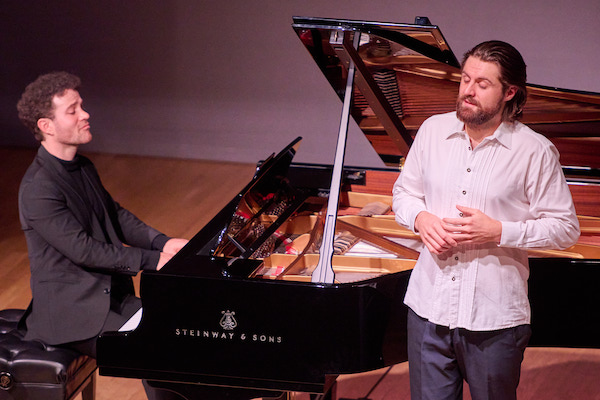
Similarly, the duo conjured up an exquisite sheen of stress when the roar of the mill-wheels break through the brook’s babbling in the third song, “Halt!”
Krimmel consistently used his exquisite vocal control in the service of expressivity. A simple thing like going up a scale and then pulling back the volume on the top note can carry a stab of poetic meaning, as when the miller described his first vision of “the maid of the mill” (“Zur Müllerin hin”).
The forceful “Am Feierabend” (“When Work Is Over”) was a highlight. The melody charges over aggressive piano triplets, until “work is over, in cool and quiet,” when sound and tempo hold back – only to burst into a tragic mood at the close of the song when the miller realizes the maiden’s “goodnight” was addressed to everyone present and not just to him.
“Sleep-drunk Eyes”
The third verse of “The Inquisitive One” sounded like a prayer, but the music gets more earthy after that, both hopeful and forlorn as the miller agonizes over whether the maiden will say she loves him. “Morning Greeting” too reveals Schubert’s facility with varying the mood within the confines of a short song – drowsy as the miller contemplates her “sleep-drunk eyes,” haunting as he asks “Why do you fear the sun?” These afforded Krimmel prime opportunities to live the songs much as a great cabaret singer does.
As the baritone sang of “The Miller’s Flowers,” giving the lines a gossamer glow, one could read in a whiff of creepiness as the miller camps out under his beloved’s window. But things then go well, and Krimmel’s silken tone expressed the poetry in lines like “At that my eyes brimmed over / The watery mirror grew blurred.”
He summoned a blast of energy to marshal “Der Jäger” almost as a patter song, brought frantic power as jealousy overcomes our hero, and gave a lovely lyrical quality to the funereal “Die liebe Farbe,” a high moment among many thanks to Krimmel’s velvety singing and Bushakevitz’s deftly sensitive playing.
Things go sour for our miller, and in a gripping song in which the maiden’s favorite color turns “evil” for him, Krimmel turned the lines “So stolz, so keck” (“So proud, so bold”) into a near-shout. His marvelous dynamic control emerged again as he sang of flowers over the grave of the devastated lover.
The lullaby that closes the cycle leaves us with a sad, poetic sort of satisfaction. And these performances left me with nothing but admiration.
The duo’s Schubert series continues with Winterreise on Dec. 5 and the Schwanengesang on Dec. 7. Visit the 92NY website for in-person and virtual tickets. Next up for Konstantin Krimmel: Die Fledermaus in Munich. Will we have many more opportunities to hear a singer like this in recital in a relatively intimate venue?
Pianist Ammiel Bushakevitz’s latest Schubert album is available now.