 Blogcritics The critical lens on today's culture & entertainment
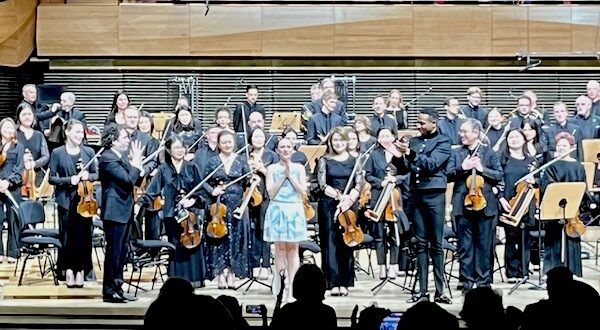
It seemed a golden opportunity for a first experience seeing and hearing Gustavo Dudamel, Music and Artistic Director Designate of the New York Philharmonic, conduct the orchestra. The Firebird Suite by Igor Stravinsky was one of the pieces that saw me through adolescence and I’ve retained a soft spot for it ever since. With Schubert and Wagner also on the menu, plus a New York premiere by Pulitzer Prize-winner Ellen Reid, I had high hopes.
There was a lot to cheer at the third of three performances by the NY Phil with the New York Philharmonic Chorus, on May 2, 2026 at David Geffen Hall. And although Reid’s piece came first on the program, it, not the Firebird, proved the real centerpiece.
The Elements
An unstated theme knitted the program together: the four “elements,” earth, air, fire, and water. The contiguous movements of Reid’s Earth Between Oceans bear those titles. The music evokes those mythologically fundamental elements with worldly force and a raw complexity.
One thing that unifies the four movements is a penchant for contrasting beats – not polyrhythmic, because out of time with each other, but emerging separately from different sections of the orchestra and overflowing one another, with one ultimately forcing the other offstage.
And even before the arrival of a driving beat of any kind, the crashing piano-and-cymbal rumbles at the beginning of “Earth” are pocked with syncopated accents. This immediately suggests the random vagaries of nature over artificial musical constructs. Reid does introduce a gentle ternary beat, but quickly shatters it with thundering brass, out of which a lone cello rises – only to be subsumed in turn by a mighty cacophony of horns, strings, and voices.
The choir merges but also emerges. Reid employs it wordlessly, as another section of the orchestra rather than a vessel for specially defined meaning as it declares, together with the violins, the development of a soaring motif.
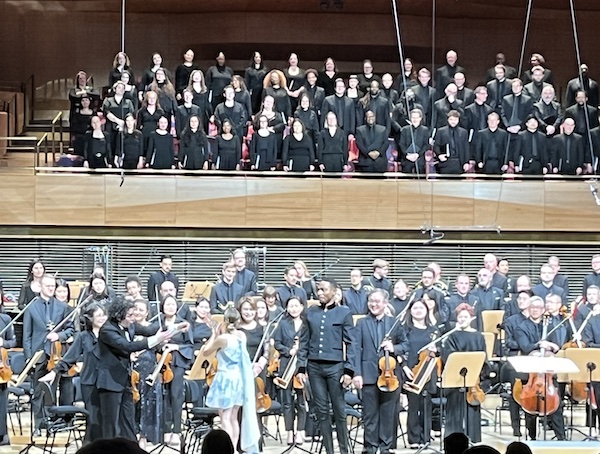
A return of the piano-cymbal rumble wafts us into “Air.” This movement is remarkable for quivering, bubbling vocal effects unlike anything I’ve heard from a choir before (and I’ve heard a lot of unorthodox vocal techniques over the past few years). This produces an effect unearthly and almost terrifying, before the singers settle into gorgeous if still eerie harmonies laced with whistling effects. In “Fire” Reid masterfully combines unison writing, rhythmic surprises, and increasingly panicky percussive beats. Cascades of sound, at first toneless, introduce “Water.” Melodic outlines emerge in the strings and an insistent beat supports a triumphant theme from the still-wordless voices.
At times it’s hard to distinguish which section is producing which wash of sound, something I found strangely powerful.
The piece received a rousing reception from the audience as a whole. But I also overheard quite a bit of intense discussion among several individuals (strangers to one another) sitting near me, not all of it positive. The music can challenge expectations of a piece that explicitly “depicts” familiar images and ideas.
And at 30 minutes, Earth Between Oceans is indeed massive. I found it massively musical, and just as mind-shaking. Now I understood why this one piece, whose total time is significantly less than half that of the program as a whole, was programmed alone before intermission.
Parts of Speech
Schubert scored his part-song “Gesang der Geister über den Wassern” (“Song of the Spirits over the Waters”) unusually: for lower voices and lower strings, just tenors and basses with violas, cellos, and bass viols. That may be why it’s not too often performed – I had never heard it, anyway. But I found this performance very satisfying. Dudamel vividly realized the variety of song styles Schubert used in scoring each of the six verses of Goethe’s poem, which compares human life to the flow of a waterfall.
The scoring made some of the harmonic movement feel dark and strange at the start. The music goes on to take in a beautiful looping melody, dramatic leaps (“When rocks loom up / [The water] plunges against them”), divine vocal harmonies, and a folksiness (“Wind is the waves’ / Beloved partner”) that transitions quickly into seriousness. Dudamel moved smoothly from one tempo and beat to the next, enhancing the sense of variety. The skillful work by choral director Malcolm J. Merriweather, who also directs the Dessoff Choirs, might have been easy to overlook, but was worthy of note here, and even more so in the Reid.
Forest Fire
More often heard is the concert arrangement of “Waldweben” (“Forest Murmurs”) from Wagner’s Siegfried. As it does in the opera, this music provided a nice birdsong-laced interlude, without succumbing (heaven forbid!) to unadulterated pastoralism.
The Philharmonic left Siegfried behind waiting “lost in silent reverie” to drum up a new hero, Prince Ivan of Stravinsky’s Firebird. The suite’s themes rang prominently in my youthful brain half a century ago and remain coded-in to this day. On this occasion the first section felt slightly shaky amid the descending-ascending first theme, until the strings’ startling vibrato entrance. The second section, with its lovely oboe melody, seemed to amble rather than dance.
The fire of the “Infernal Dance” re-engaged my wandering attention. And I liked how Dudamel surfaced the somber aspects of the “Lullaby” while sustaining a floating feeling in a languid tempo.
And then there’s that unforgettable theme in the Finale, first hummed by a horn, then taken up in different rhythms and intensities by the rest of the orchestra. The upshot was a great sharp blast of musical wonder to light up the spirit of a cynical adult, just as it had that of an expectant adolescent all those years ago.
Earth, air, fire, and water – four elements. Not five, this time. But more than enough for a powerful concert program. One can only look forward to Gustavo Dudamel’s official tenure at the New York Philharmonic.