 Blogcritics The critical lens on today's culture & entertainment

Lights Out: Nat “KIng” Cole at New York Theatre Workshop
In Lights Out, when Dulé Hill steps out onto the New York Theatre Workshop stage as Nat King Cole performing his last show (on December 17, 1957), we have already accepted him in his dressing gown backstage in another mood: angry, regretful, subject to imaginative flights of fancy and ghosts. Backstage, we learn this last show ends because it has no national sponsors, so Cole decides to pull the show himself. The dualism of Cole’s real backstage persona and his public figure in front of the cameras becomes clearer and more intense throughout.
This dichotomy starts when he emerges from being plied and powdered with makeup to appears “whiter” before the TV cameras. This “whitening” Cole deems a grave insult.
In Front of the Cameras
In public, we see his demeanor change to his public persona, and note his tailored, blue period suit, meticulously coiffed hair, and mellifluous speaking voice. Then we leap onto the train of Cole’s legendary glory, ready to ride its peaks and valleys as we learn about the singing star. Cole’s amazing talent garnered world-wide fans. His half-hour TV variety show, which he hosted for over a year, was slotted for 53 episodes, the Stage Manager (Elliot Mattox) announces. However, without national advertisers, Cole’s show ends one week before Christmas Eve, replete with Christmas tree, presents, and his popular Christmas songs that are still played today.
Hiding his regret and anger, the pianist and singer said his final goodbyes to his audience on his own variety show, an unheard of first for a Black performing host. We discover these not widely known facts and see Cole’s imagined response to the situation in Lights Out, written by Colman Domingo and Patricia McGregor and directed by McGregor. The poignant, must-see production runs at NYTW until June 29, 2025.

Black Entertainers’ Experience in America
The musical explores the circumstances of Cole’s last show, symbolically encapsulating Black entertainers’ experience in a bigoted, racist America. These are highlighted at one point via rapidly flashing black-and-white photos of historic racist events in America projected on the back wall, showing us what Cole faced daily. Vitally, Lights Out parallels our time. Though one might think that culturally the situation today is different, in reviewing Cole’s situation, writers Colman Domingo and Patricia McGregor reflect issues of the present day. Though some may be loathe to admit it, bigotry and racism sneak into institutions and reside in the numbers, from CEOs to political officials, up to the present political administration which pridefully displays its bigotry and encourages the unnatural, irrational repudiation of “diversity, equity and inclusion.”
Against this backdrop Domingo and McGregor imagine Cole’s experiences to reflect our time. They remind us how performers like Cole forced themselves to negotiate their anger in the face of sly, bigoted insults in the North from friends, like his producer (Christopher Ryan Grant), who slips in the occasional demeaning insult. Nevertheless, Black performers like Cole expressed their exceptional talents to the often inferior, prejudiced, and cowardly white patriarchy who exploited them because they could. After all, then as now whites held most of the reins of power and money. Throwing crumbs under the table to Black performers maintained whites’ happy status quo.

Sammy Davis, Jr. as Cole’s Alter Ego
To convey Black performers’ fury at such oppression and inequity, Domingo and McGregor heighten the ironic humor of the character of Sammy Davis, Jr. (the exceptional Daniel J. Watts), who shadows Cole throughout this last show as he sneaks in ironic comments on social justice. For example, Davis, Jr. says, “They are still digging Emmett Till’s grave and you’re out here planting roses.” Cole responds, “It’s my job to entertain.” Watts’ Sammy counters, “No, it’s your job to reflect the times.”
Thus, Sammy, with sardonic asides and references to the evils of racism, presents himself more like a court jester, or Cole’s alter ego. Domingo and McGregor use his character as a device opposite to “mild-mannered” Cole. Sammy guides Cole to pull out all stops on his last show. What Cole perhaps would never express, Sammy Davis, Jr. suggests with his “shuck, jive, dance, and gestures” as a clown performing for “the man.” Of course all the while Watts’ Sammy, who grins from ear to ear, implies he’ll play the game and in the process, turn over “the man” and game him, a process that flies over slow-witted racists’ heads.
Cole’s Subterranean Rage
At the top of the musical, with the introduction of Watts’ Sammy characterization we receive the first notes of the sub rosa fury that Black performers feel but must tamp down for the sake of their creative lives. Hill and Watts in their roles, expertly reveal their characters to be dynamic complements to each other as each struggles against the untenable situation that abides. A sensational number during which they dance their shoes off, “Me and My Shadow,” brings down the house. Hill and Watts are terrific together.
Obviously, whites accept Cole’s program up to a point, especially if he keeps his distance from white female performers – no kissing or hugging or touching – like friends Betty Hutton and Peggy Lee (Ruby Lewis plays both). When Eartha Kitt (Krystal Joy Brown) shows up and sings and Cole joins in (“What’s Wrong With Me”), it’s OK for him to kiss her because she’s Black. Still, Cole must “keep it clean.”
Finally, friend Peggy Lee arrives, really too late to go on, but they sing a few bars of a reprise of “It’s a Good Day.” We know that her agent has persuaded her to be late, because advertisers and producers fear the South boycotting the show and making a stink. She avoids the fallout. Meanwhile, Cole always follows the rules, pandering to whites while repressing his rage.

A Successful Failure
As a result Cole swallows his pride and puts up with all the indignities, hoping his show will stay alive. At the last minute the producer suggests a pathway to gaining an advertiser in order to keep Cole’s spirits up so he can deliver a sensational last show. The advertiser they find is a cigarette brand (Lucky Strikes in disguise), a product that Cole freely used. Domingo and McGregor imply with sardonic irony in a surreal scene that the brand was especially created for Blacks to smoke, to kill them. Cole died of lung cancer and Sammy Davis, Jr. died of cancer related to smoking. We see both smoking before and during Cole’s final show.
Key Numbers from the Nat King Cole Catalogue
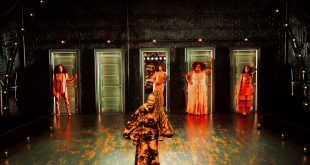
Lights Out includes Cole numbers, with the live band fronting as the Nelson Riddle Orchestra. John McDaniel does a superb job with the music supervision, arrangements and orchestrations. The sequence of scenes flashes back and forward in time poetically, figuratively, not chronicling the show factually from start to finish. It’s a “fever dream” where the characters revolve in and out, mingling their perspectives with the musical numbers urgently, as time runs out.
Indeed, as Sammy suggests, this is not “an easy holiday show.” Instead, Cole’s psyche (his backstage self) reveals his pressures, tensions, rages, passions, joys. He even converses with the ghost of his mother via his imagination, and he sings the beautiful “Unforgettable” with daughter Natalie (Krystal Joy Brown), reflecting a future time in the 1990s when she sang with her father in a digital re-creation long after he died.
Time is Fluid
One questions when the show actually starts, as guests and family members arrive and leave and Sammy shines triumphantly ironic. The mashup succeeds, ferociously examining the present through the past. One weeps for the tragedy of the suffering that Nat King Cole, Sammy Davis, Jr. and other Black performers endured in silence.
Lights Out is heartfelt and wonderful. We can’t get enough of Hill’s Nat King Cole, Watts’ Sammy Davis, Jr., and the ensemble’s superb performances and singing. The show magnifies our country’s history through music and an experimental, surreal book. It reminds us of where we were historically and gently frightens and chides us about where we are today. For that and the creatives’ and ensemble’s exceptional efforts one should see Lights Out before it closes.
Lights Out: Nat “King” Cole runs through June 29, 2025 at New York Theater Workshop.