 Blogcritics The critical lens on today's culture & entertainment
The Whoopi Monologues
Whoopi Goldberg achieved EGOT status (Emmy, Grammy, Oscar, Tony) in 2002. She came to prominence with The Spook Show, a one-woman tour de force of various character monologues. After Mike Nichols saw the production, he mentored her to bring the show to Broadway (1984) re-titled The Whoopi Monologues. The dynamic production won multiple awards.
Twenty years later Goldberg starred in her revival of The Whoopi Monologues. She received a Tony nomination for Special Theatrical Presentation.
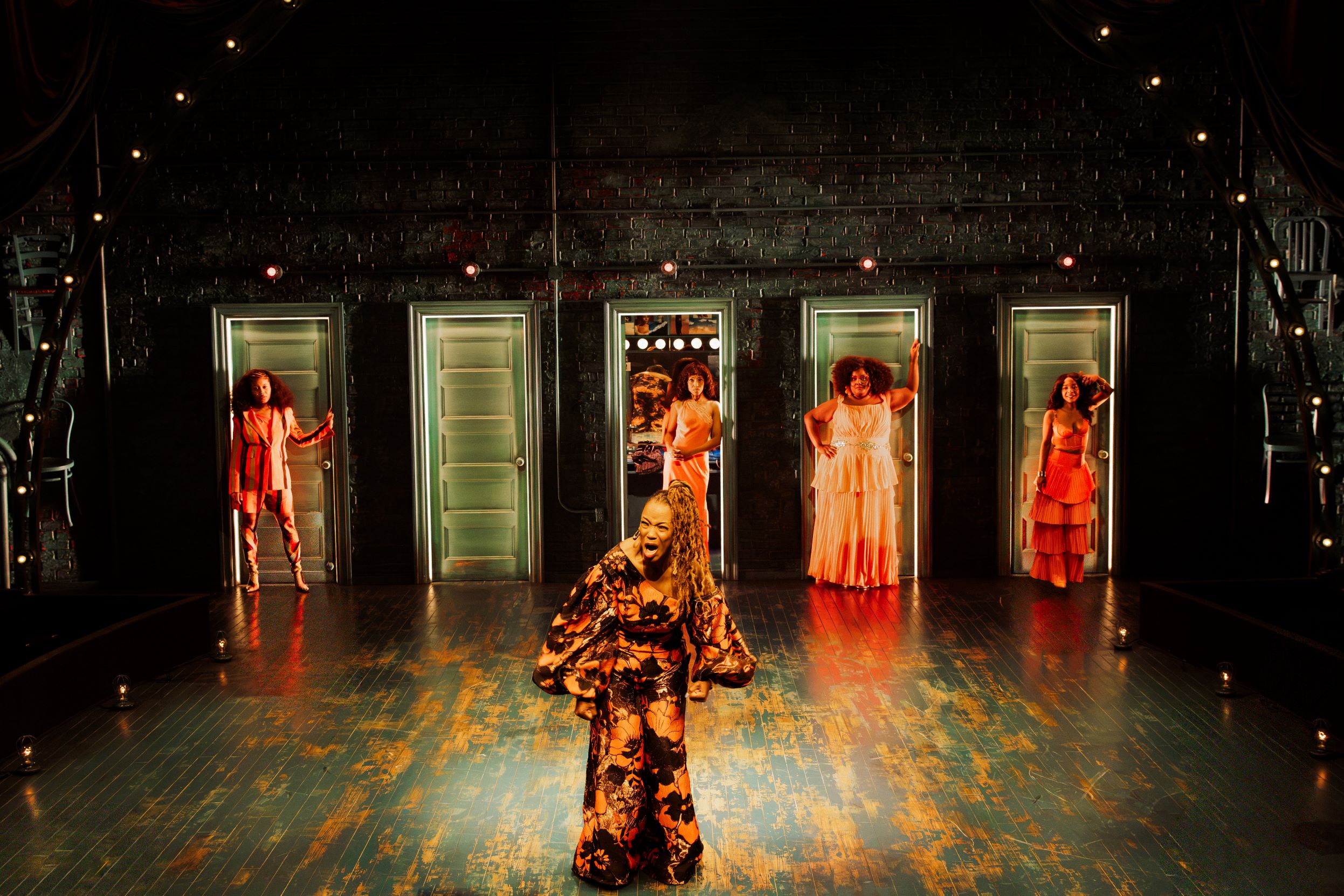
Now, with a new twist of theatricality and pizzazz, The Whoopi Monologues runs at the intimate Off-Broadway Mitzi E. Newhouse Theater at Lincoln Center. Award-winning director Whitney White sets up a winning combination of Goldberg’s humorous, heartfelt characters portrayed by five award-winning actors. The production’s subtle topicality rings with truth and gives a nod to Goldberg’s genius.
Past and Present
Themes of the past meld with the present in a timeless loop. While everything changes, nothing changes. In their complexity and vulnerability, the sensitive and nuanced portrayals show us what we should laugh about in ourselves and how we should not be upended by life’s inevitable sorrows and injustices.
Hana S. Kim’s video projections of Black celebrities scroll against a backdrop of dressing room doors (scenic design by Studio Bent). Kerry Washington, who also produced the show, emerges to Fan Zhang’s original music, an eye-popping rhythmic collage. Washington introduces the actors, five talented Black women who seamlessly manifest Whoopi’s characters. Later in the production, Washington herself portrays Surfer Girl.
Fontaine
First up, Kara Young’s brilliant Ph.D. turned drug user, Fontaine, appears. “I got a Ph.D. I can’t do shit with. So I stay high so I don’t get mad.” Her snide, energetic, interactive patter arouses our enthusiasm. But Fontaine’s pointed description of how she ended up in Bellevue after a harrowing flight with a fire on board is frightening. Particularly galling was the flight attendant’s “Shh!” which set Fontaine to “freaking out.” She continues screaming during deplaning, and medics put her into a strait jacket and ambulance to Bellevue. There, doctors readjust her thoughts. After 10 weeks they release her. The revelations in her monologue carry warnings.
Blonde Girl
The Blonde Girl (Kai Heath covered for Dominique Fishback when I saw the show on July 15, 2026) wears a white shirt on her head to pretend her golden hair shines. Heath drew sympathy for a character who despised her “Blackness” and dreamed of turning into the women she sees on television.
Fascist-tinged images of “white blonde and blue-eyed beauty” have psychically damaged generations of women young and old. From anorexia nervosa to surgical botch jobs and disfigurations, women like the Blonde Girl have suffered to “measure up” to the impossible changing fantasy of beauty. Goldberg’s revelations reverberate even more trenchantly today.
Rollicking Jamaican Lady
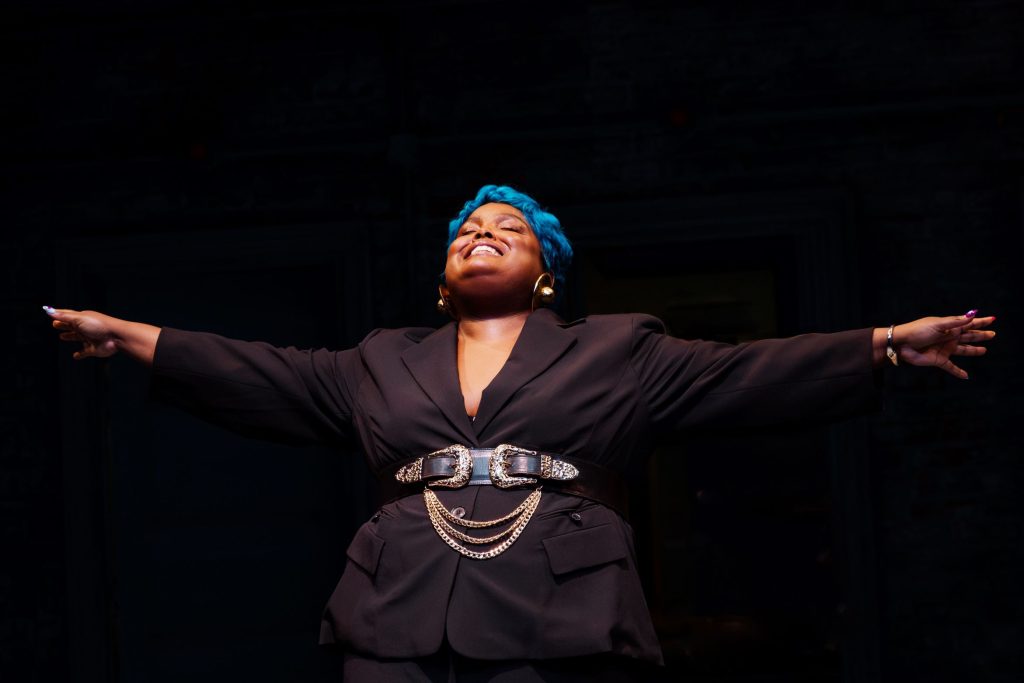
Next, the Jamaican Lady (Danielle Pinnock) recounts her move to the United States to care for an old man whom she refers to as “an old raisin.” Queen Jean (costume design) and Nikiya Mathis (hair and wig design) pull out the stops with the Jamaican Lady’s blue hair and gold-plated accessorized outfit covering a partially see-through bustier. Jamaican Lady’s outsized, jovial personality warrants the outfit. This humorous story embodies the American dream and hoped-for immigrant success story. Pinnock’s refreshing, spot-on performance belies the current situation with immigrants from the islands. Hers is a throwback to a time when “dirty old men” sweetly kept their promises.
Surfer Girl
Kerry Washington’s Surfer Girl sounds like a “Valley Girl,” loves to surf, and feels connected to the ocean. “There’s water in my body and water in the ocean and like we pass water, water passes us.” Though she appears to “have it all,” she runs into trouble, and a priest, nuns and her mother don’t provide comfort or support for the 14-year-old. She’s left to her own devices.
Unfortunately, the stereotype of “abortion with wire hanger” has updated to the present with the reversal of Roe v. Wade and aligns with what women like Surfer Girl barbarically did if they didn’t have any choices. Including this character in these monologues helps clarify Goldberg’s theme that human rights must trump all else. Maybe nothing has changed, but neither has that.
Lurleen
In the final portrayal, Lurleen (Kecia Lewis), another outsized personality, “appreciates” the menopausal state of her femininity. By the time Lewis’ Lurleen completes her stories of physical, emotional and psychic changes, even the men in the audience are laughing through their tears. Importantly, Lurleen covers gender inequities as they relate to women’s vast ignorance of their bodies, while men learn to focus on their reproductive organs obsessively (cf. open-stalled urinals in bathrooms). This monologue should be played for women of all ages and especially women after they’ve decided on no more children.
Lurleen’s raw, priceless wisdom dances with humor and pathos. As she wraps up with surprising revelations of her struggle to redefine herself as a woman, White cleverly brings back the other women. Their uplifting celebration of life leaves the audience joyous in laughter with bittersweet reminders that we have a long way to go to achieve human rights for all.
The Whoopi Monologues runs through August 30, 2026 at the Mitzi E. Newhouse Theater.