 Blogcritics The critical lens on today's culture & entertainment

With musical wizard Dan Schlosberg on a break, would Heartbeat Opera’s latest production, a reimagined Faust, offer the musical magic that has made its predecessors so deliriously impactful and fun? Happily the answer is yes, thanks to skillful and imaginative arranger Francisco Ladrón De Guevera, the rest of the Heartbeat Opera team, and a terrific cast with thespian skills to match their singing voices.
Shadow screens. Puppetry. A silent-movie sequence. This two-hour compression of Gounod’s full-length opera has everything but an intermission. Heartbeat Opera stagings typically use a small band rather than a standard orchestra. This instance includes brass, reeds, and other typical instruments, with artistic director and violinist Jacob Ashworth conducting. But it also features a harmonium, lending the production a street-smart proletarian air.
A Timeless ‘Faust’ from Heartbeat Opera
As always, Faust’s story begins with the doctor alone in his study, despairing over the lack of meaning in his life. The costuming and a modern desk suggest a time reasonably close to the present, a setting further reinforced when our introduction to Valentin, Wagner, and Siebel takes place in a neon-decked hole-in-the-wall bar.
But the production also has a timeless feel. Exactly what poisonous concoction is the suicidal Faust stirring up on that tube? What patriotic war are Valentin and Wagner off to? (It’s hard not to think of them right now, if only for a moment, as Ukrainians.) And from what century, what plane of existence, comes red-clad Mephistopheles? The tale of Faust never grows old precisely because there’s a devil in every place and time.
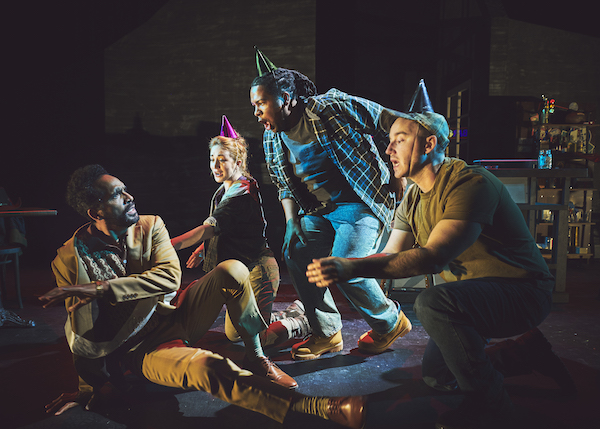
Ashworth and director Sara Holdren adapted the original French libretto, presented with arch English supertitles. Holdren also contributed new vernacular-English dialogue that adds humor and bolsters characterization. While eliding recitative to shorten the production, these sparse speaking intervals add to the humor and the working-class flavor.
Voices Carry
Tenor Orson Van Gay II and baritone Alex DeSocio have commanding voices as Faust and Valentin respectively. Van Gay does a nice job embodying a weird, difficult character – a romantic lead who is also a wannabe-libertine and an abandoner, someone we can empathize with only to a very limited degree. His overall warm tone makes his high notes surprisingly piercing in an uplifting way.
The softer-voiced baritone John Taylor Ward embodies an ickily magnetic string bean of a Mephistopheles, whether taking center stage or lurking in the background observing his mischief. Marguerite, when we finally meet her, is quite soft-spoken too, through the voice of soprano Rachel Kobernick. At first we have to lean in to hear her. The low volume makes her all the more effective when later heights of passion draw the full resonance of her voice.
Powerhouse mezzo Eliza Bonet revels in her bigger-than-life comedic chops as well as her bell-tower voice. And I was sad that we couldn’t see and hear more of the impressive and funny Brandon Bell, whose character Wagner doesn’t make it home from the war with Valentin.
AddieRose Brown’s Siebel, here a female rather than a pants role, had the audience hushed with her “Faites lui mes aveux.” This is one of a number of strongly performed arias that draw us in to the cleverly mercurial set (by Yichen Zhou and Forest Entsminger) and help make the production feel intimate.
In the Shadows
The time period gets wobbly, with Marguerite hanging her laundry to dry outside the undefined religious structure where she lives, and one of Faust’s scenes going mime with silent-movie caption cards. Importantly, Holdren’s staging finds many delightful uses of two skillful puppeteers (Rowan Magee and Emma Wiseman), from making objects seem to float magically in the air at the devil’s command to enacting a Punch-and-Judy-style puppet drama encapsulating Faust’s pursuit of his prey/beloved. The show also uses shadow screens very nicely; for example, a duet scene with Faust and Marguerite facing each other from a distance becomes, in shadowland, a slow approach to a kiss.
The production doesn’t glide over the story’s misogyny and the cruelty of all its main male characters. Faust’s double nature is glaring, and Valentin is no better, singing first of his devotion to his sister, then, as he dies, cursing her for giving in to natural human desires. This Faust does deliver a surprise at the end that speaks powerfully to the matter. Though not in the opera proper, it’s in line with the whole smart, sinewy production.
Gounod’s Faust is in itself a pretty poor example of storytelling. But it’s filled with beautiful, interesting music, which is here in all its glory despite the abridgment. Heartbeat Opera’s gripping, innovative production runs through May 25 at the Baruch Performing Arts Center in NYC. Tickets are available online.