 Blogcritics The critical lens on today's culture & entertainment
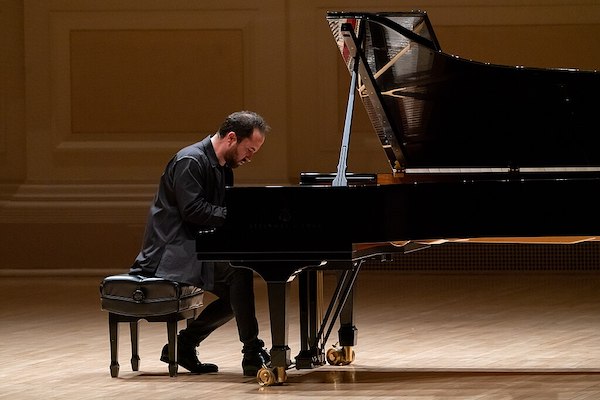
Sony Classical is out with a new three-CD set of music by Johannes Brahms from pianist Igor Levit and the Wiener Philharmoniker conducted by Christian Thielemann. The recordings of the two piano concerti sound almost vinyl-warm, and I mean that in a good way. I’m sure it’s partly the acoustics, including the reverberation, of the historic Vienna Musikverein. But it’s also Thielemann’s soft entanglement of the orchestra with Levit’s glowing tone. The performance draws out many subtleties, especially in the thorny Piano Concerto No. 1.
The Impassioned Young Brahms
The piano’s first entrance in the opening movement is a patter of soft silver. From there the long first movement flows peripatetically as the composer threw just about everything he had at it. In this performance, clarity is there but takes a bit of a back seat to expressivity. Exquisitely beautiful passages tumble one upon the next, explosives following sighs that follow tense mini-voyages of technical fireworks.
The movement may be a bit chaotic but it’s one of the most perfect exemplars of the Romantic spirit, suffused with the fecund creativity that made Brahms a talent like nothing seen before or since. It’s worth noting that Brahms wrote it just after his champion Robert Schumann’s suicide attempt. You can hear in the performance that, as Levit says in a conversation with Thielemann recounted in the liner notes, it “takes quite a lot out of me emotionally and psychologically.”

Levit deeply inhabits the sneakily radical, lullaby-like piano writing in the Adagio second movement. Again there is a wandering quality to the score, but the orchestra and pianist suffuse the journey in a potent perfume.
The finale is less of an emotional battlefield than the first movement but replete with glorious piano vocabulary and dazzling playing on Mr. Levit’s part. The second theme, in a major key, is at first a relief from the swirling emotions, but develops into another display of inventiveness, this time more tightly wound. Both orchestra and pianist dive with what sounds like all they have into the flurry of drama at the end.
The Mature Brahms
In the Piano Concerto No. 2 the warm sound persists, but the greater clarity in the music itself results in a brighter quality to the performances. Mr. Levit is at his expressive best here, beginning with the stirring, cinematic, and crisply played first movement. It’s a triumphant account by pianist and orchestra alike.
Interestingly, the emotionality is perhaps even more pronounced in the subtler Allegro Appassionato, a kind of gargantuan minuet. This is piano writing that can be readily overdone in performance, but Levit avoids that temptation, letting the meaning flow plainly from the notes, harmonies, rhythms, and interplay between soloist and ensemble as written.
The slow movement displays the synchrony between pianist and conductor at its most exposed, and thus most impressive. The quietude of the softest passages makes you lean in to absorb the music, and the music responds rewardingly. As the cello and piano work together towards the end, I found my eyes welling up.
The scampering strains that begin the finale presage a sunny apotheosis. But when the main theme enters we know we’re in for something more rounded, with more than a touch of dark magic. Thielemann leans into these string passages less heavily than he might, which along with Levit’s pristine high-register technique lights up the music, aided by fine playing from the woodwind section in particular.
Every time I hear this concerto I change my feelings about which movement is my favorite. In this recording all four move me equally in distinct ways.
A Piano Lesson
Disc 3 is all Levit playing a set of Brahms’ late piano works. He gives the well-known Opus 116 No. 2 Intermezzo, the second track, an unusually slow and quiet treatment. Lean in for this one, and be prepared to do it again, as the CD is defined more than anything else by soft-spokenness.
The Opus 116 No. 2 is just one of the pieces here that play like tiny suites, with multiple sections and themes telling more-or-less abstract stories in sequence. Other units in Opus 116–119 speak softly throughout. But in all the quiet sections and pieces, as for example the Opus 116 No. 4 Intermezzo and the Opus 117 No. 1, Levit channels a gentle spirit that one can easily picture having activated (overcome?) Brahms in his old age.
While the composer may have achieved tight control of his fiery side at that point in his career, these late works also contain many impassioned passages. Levit approaches these with much feeling but also great clarity, which sometimes reads as deliberation. It’s an interesting attitude that doesn’t harm the music; in fact it generally works well and I find it refreshing. It can, though, occasionally rob the music of a bit of its suspense or, as in Opus 117 No. 3 with its dark key of C# minor, the subtle menace that Brahms could sometimes spit into his mixing jar.
The splashy passion of the Opus 118 No. 1, followed by a decidedly un-histrionic rendition of the oft-heard No. 2, together encapsulate Levit’s approach. The first has something of the roar of a hurricane, while in the the much-loved A major Intermezzo he doesn’t even tiptoe near the forte markings most pianists follow more literally. Yet his light touch leaves room for dynamic range. It’s another lean-in number, and it works divinely for this exceptionally beautiful piece whose every detail deserves attention.
The Opus 118 No. 4 by contrast is full of flame, and the No. 5 “Romance” abounds in the kind of childlike simplicity familiar to lovers of Chopin, who achieved this the exposed sections of some of his nocturnes. Indeed a good part of this album’s success comes from the pianist’s smooth and well-considered dynamics. The crescendos in Opus 116 No. 6 provide a fine example.
The Timeless Power of Pure Music
Brahms designated the majority of the pieces in these collections as “Intermezzi” to indicate their abstraction from traditional classical-music dance (or any other) forms. Levit’s performances of the first two Intermezzi of Opus 119 stand out for their glassy delicacy, interrupted by staccato explosions in the latter part of No. 2. Together with the impassioned Intermezzo No. 3, whose edgy force belies its C major key, they benefit like the rest of the CD from the pianist’s spare use of the sustain pedal. Most importantly, they make decisive and eloquent statements without demanding or even suggesting the listener must associate them with any particular form or tradition.
Tying Disc 3 to the Concerti on 1 and 2 is a piano four-hands arrangement of the famous Waltz in A major, probably Brahms’ most beloved piece, with Thielemann himself joining Levit at the keyboard, capping off their warm collaboration.
I stand in abject admiration of Levit’s interpretative imagination as well as (almost needless to say) his fine technique. And the orchestral performances here, from a storied venue, bring the listener back in time to the creation of timeless music that feels as vital and emotionally stirring today in our anxious digital world as it did in the 19th century.