 Blogcritics The critical lens on today's culture & entertainment

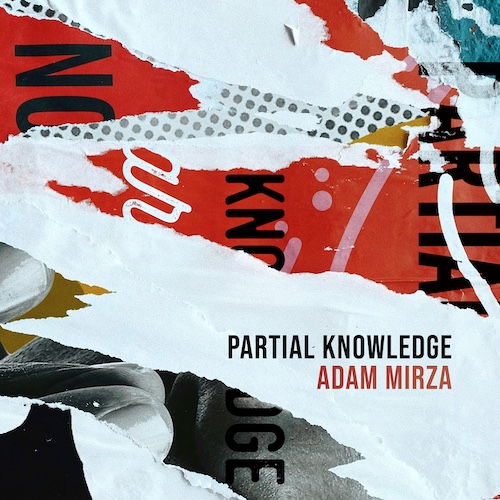
Between 2002 and 2017 composer Adam Mirza encountered many musicians and ensembles based in New York City, where he lived. The music on his first solo album, Partial Knowledge, composed between 2006 and 2022, evokes to my NYC ears some of the urban chaos we city-dwellers face.
“Each work,” Mirza explains, “in one way or another, celebrates the individual perspectives – the partial knowledge – of musicians within an ensemble.” In effect this means each musician’s part runs to some degree independently of the others. The results can be confounding, thought-provoking, and evocative, sometimes all at the same time.
Urban Soundscapes
Mirza’s description of “Reading: (A Mish-Mash) / For a Man / I Will Never,” the eight-minute opus that opens the album, as a “city-like collage” is spot-on. Readings of the poetry of Larry Eigner, whose cerebral palsy informed both his work and the way he produced it, accompanies four instrumental parts delivered by the members of the prominent new-music ensemble loadbang.
Atlanta forms the urban landscape of “Growth.” Four instrumentalists play together while triggering audio elements electronically, and these in turn affect the audio processing of the others’ performances. Enhanced by the electronics, the clarinet, violin, cello, and piano sing of a bustling city. Like much of the album, the piece might make one imagine that a live performance would offer a more complete realization of the composer’s vision. But it’s an effective evocation of urban energy and mystery nonetheless, ending with a sound that suggests a plane about to land – or crash – suddenly cut short.
“Cracks” for alto sax, percussion, and fixed stereo audio takes further the idea of sounds emanating from specific locations. It was originally written for a particular performance venue with particular positioning in mind. To help recreate the effect in other spaces, Mirza created a stereo backing track of “objects creaking and groaning as I stepped on them or dragged them around.” I’m not sure it has the desired effect on the recording. Though it does create a sense of space, I find I’m not able to get my mind very well around these eight minutes of stop-and-start “parts.” To be honest, the piece tried my patience.
String Explorations
“QXTR” for string quartet firmly embodies Mirza’s technique of independent parts, while also reinforcing an affinity for string instruments. The four musicians “perform four quasi-independent solos at the same time. It is presented entirely in parts; there is no score.” The result is a mishmash of squeals, shrieks, moans, guttural gestures, and hurried scales. Despite this busy-ness the piece creates a sense of timelessness and self-perpetuation, without start or end. So that when the quiet finish does come, it feels more like a preamble than a coda.
“Shared” for string trio is the most recent work on the album, dating from 2022. Here Mirza further explores the possibilities of the small string ensemble, this time coordinating the individual components to create a series of varied morsels, “interactive zones” as he calls them. Again squealing and scratching effects are prominent, but this time the instruments play off one another with intentionality. An episode of standard technique in the seventh minute centers the piece on an acknowledgement of tradition, but the piece trails off in a halo of soft harmonics, topped off by a few gruff but hesitant string-strikes.

“Time Patterns” is an earlier work performed here by violinist Olivia De Prato. Mirza sought “a freely gestural, solo performance unburdened by constraints of fixed pitches or clock-time rhythms.” The language of the piece comes not from tones and rhythms but the physical parameters of how the instrument is played. The piece closes the album, but represents one starting point for many of the other explorations we encounter on this album.
Triangles
Mirza seems to leave the city behind on the album’s longest work, “Triangles,” constructed of mostly-unsynchronized parts for flute, violin, and piano. Though punctuated by sudden interjections, its slow progression creates a contemplative, even pastoral mood. Extended techniques on the flute and violin expand the sonic horizon to enfold images of the natural world. The piece can be seen as employing the language crafted in “Time Patterns” to tell a deeper, perhaps more meaningful story – perhaps reflecting rural landscapes one might pass through on a journey between metropolises like Atlanta and New York. As I write this in my NYC apartment, sounds of wind and rain, sirens, car horns and passing traffic, and my own tinnitus form a mesh of unsynchronized, in many cases unrelated, yet inextricable sound elements. It sounds rather like Adam Mirza’s world.
Partial Knowledge is out now on New Focus Recordings.