 Blogcritics The critical lens on today's culture & entertainment

We often speak of “Western” and “Eastern” music as discrete, distinct, and in some essential way incompatible. That’s silly. Popular culture and classical tradition alike disprove it – from George Harrison incorporating the sitar into Beatles music more than 50 years ago, to leading lights of Chinese music holding vast classical music festivals today. Many groups, such as Akshara Music Ensemble and Hot Club of Los Angeles (the latter carrying forward a style tellingly called “gypsy jazz”), pointedly merge musics from around the globe.
Nevertheless, people reared in the Western classical tradition tend to view music from East and South Asia as creatures of a different species, with whom they can make friends but not interbreed.
All for One
This conceptual barrier is an illusion. Such crossbreeding has taken place for centuries, if not millennia. Sharon Isbin made that point at the “Strings for Peace” concert at Symphony Space on Thursday night. The Grammy-winning classical guitarist recalled that upon first encountering Indian classical music, she recognized kinship between the Spanish flamenco style, so influential in classical guitar playing, and Indian ragas. That connection came via music brought to Western Europe around the 15th century by migrating Romani people (once called Gypsies), whose roots are in India.

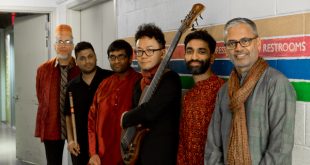
The “Strings for Peace” collaboration dates back to 2018–19, but the Symphony Space concert was its New York City concert debut. Presented by the World Music Institute, which is marking its 40th birthday, the concert featured Isbin, sarod master Amjad Ali Khan, Khan’s sons Amaan and Ayaan Ali Bangash, and tabla virtuoso Amit Kavthekar.
To underline cross-cultural influences, the guitarist opened the program with a solo performance of Francisco Tárrega’s popular “Capricho árabe.” Many listeners would recognize this piece, even if they don’t know it by name, perhaps from movies and television, perhaps from listening to classical music broadcasts.
Before Amjad Ali Khan took the stage, Isbin then joined first Ayaan Ali Bangash and then Amaan Ali Bangash in music composed by their father. The sarod takes more preparation before playing than the guitar, with, for one thing, more strings in need of tuning. Ayaan’s initial tuning itself sounded beautiful, set against the everpresent drone that typically accompanies Hindustani music.
“Sacred Evening” and “By the Moon” followed a common structure: a dreamy, meditative start, melodic leads alternating between sarod and guitar, and a driving rhythmic section with impressive unison playing among the two string instruments and the tabla. It’s those exciting unison passages that drew mid-piece outbursts of applause.
Sarod and Guitar
Beyond the mere fact of the instruments’ different timbres, the sarod’s fretless fingerboard makes the parallels and contrasts between it and the guitar interesting. That design encourages glissandos and passing microtones, even though the scalar modes of the ragas follow the 12-tone scale familiar to Western ears. While the guitar can’t produce similar effects in a big way, it can revel fully in the Indian melodies and rhythms. And the music as written allows room for the sarod player’s individual style.
I just wrote “as written.” But it’s useful to keep in mind, as Isbin noted, that traditionally this music wasn’t written down. For years that fact prevented her from collaborating with the sarod masters. Today, she reads from scores.
Amjad Ali Khan
Here in New York City at least, audiences for world music are not just curious. They become fans. When Amjad Ali Khan came out, the crowd stood. The paterfamilias may need some support to get into position on stage, but once seated with the sarod in his hands his artistry flows.

His first U.S. tour, he told us, was in 1963. The years have not diminished the force of his musical soul. His set included ragas played on the sarod, with haunting melodies and in one case a seven-beat time signature. He also performed two taranas, songs conveyed with wordless vocals, one in nine-and-a-half beat time. His final raga was a mesmerizing duet with the tabla.

All six musicians joined forces for Khan’s “Romancing Earth,” an exciting raga in six- or twelve-beat time. I mention these time signatures because even for listeners not attuned to following these counts, they create variety, just as, say, a rock ballad differs from a rockabilly tune or a waltz from a tarantella. Time signatures that aren’t multiples of three or four play with the mind in ways that common beats like 4/4 and 6/8 don’t.
The main magic in this tradition-rooted yet expansionist music, though, comes from the fusion of the individual musicians’ spirits with a collective locking and interlocking of sound and feeling. On a fundamental level, “Western” and “Eastern” lose meaning.