 Blogcritics The critical lens on today's culture & entertainment
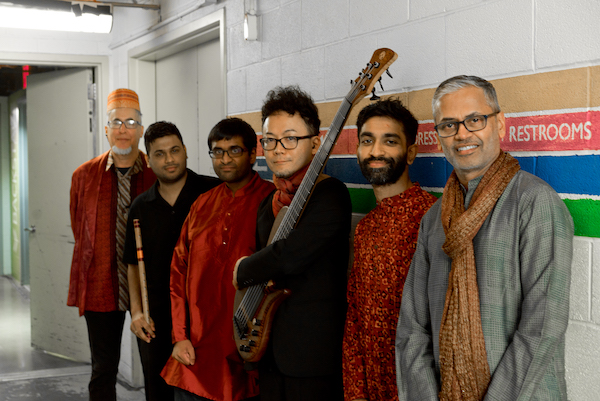
Bala Skandan formed Akshara Music Ensemble to promote and build on Carnatic Indian classical music in his own way. Performed by a fluid cast of musicians, his arrangements mingle classical ragas with elements of Western music – jazz, folk, even pop – to create a decidedly unique listening experience.
Though based in New York City, Akshara is usually on the road and so hometown concerts are rare. The Baruch Performing Arts Center (BPAC) and Lyric Chamber Music Society joined forces to bring the band to the auditorium at Baruch on March 9 for a glowing set of infectious, raga-centered, curiously multicultural music.
Merging Traditions
The lineup included both familiar and unusual sounds. Visveshwar Nagarajan played different-sized Indian flutes with solid virtuosity. Parthiv Mohan held his violin vertically and drew from it weeping, sliding melodies that slotted right into classical Indian modes. Moto Fukushima played five-string bass guitar and riffed together with the other instruments on impressive unison raga passages.

Skandan, a percussionist, songwriter and arranger, composes mostly structured music, but some songs have space for improvised solos. Fukushima lifted off for a couple of plastic-fantastic bass solos that greatly impressed your humble bass-playing correspondent. Nagarajan’s bright flute solos were highlights too.
Skandan himself held down the rhythm, his hands flying almost too fast to see on both ends of the mridangam drum, together with Kabilan Jeganathan’s tasteful beats on the smaller kanjira drum.

Voices and Smiles
The biggest surprise to me was Skandan’s vocalized rhythm-making. He explained that students of Carnatic percussion are required to sing any part they play. The bandleader simply brought this practice out from the classroom into the concert hall, producing nods and smiles throughout.
Speaking of smiles, veteran pianist Richard Bennett, a jazz player by training, rounded out the ensemble wearing an unfailing smile of delight. Though he was playing an instrument foreign to Indian classical tradition, he made the piano sound entirely at home in Akshara’s eclectic sound environment.

One could hear a jazz influence in some of the changes Bennett inserted into songs like the improvisatory “Broken.” The unison raga of “Surrender” had a jazz-ballad feel, though in 6/4 time. “Urban Kriti” opened up widely for the various players to improvise solos, and it had something of a Latin jazz feel. Guest trumpeter Indofunk Satish added a jazzy visual to the lineup on that final number, though his parts were based on Carnatic modes.
Other resonances popped up in various places. For example, “The Passage,” which led off the concert, was inspired by a children’s tale and meant to reflect small acts of kindness. It had passages that resembled Western folk-pop.
In the introduction to “Broken,” Bennett created great clouds of pianistic turbulence. His sustain pedal magnified the effect of the flexible modalities and controlled chaos he employed. It was this song that most thoroughly displayed all the complexity of Skandan’s vision: aggressive unison eighth-note statements; solemn choruses in 6/8 time; a 7/8-time break that included a bass solo (also, of course, foreign to traditional Indian classical music); another break featuring bass, flute, and violin; and more.

Bala Skandan and the Akshara Music Ensemble represent a cadre of musical artists and presenters working in countless genres and traditions to put forward music that is, as conductor Dane Lam has put it, “laboratories of listening [that] embody the possibility that people from different backgrounds, speaking different languages, can come together and create something transcendent.” Lam was speaking of orchestras and opera companies, but the concept applies just as well to bands. And how badly we need those kinds of laboratories today.
This was a real treat of a concert. See what else is coming up from BPAC and from Lyric Chamber Music Society.