 Blogcritics The critical lens on today's culture & entertainment

The Incredible Story of Cooking
The Incredible Story of Cooking by Benoist Simmat and Stephane Douay from NBM Graphic Novels is a flavorful presentation of the long history of food preparation among humans. The subtitle describes “500,000 years of adventure,” which fits with what is probably the most necessary aspect of human activity alongside shelter and procreation.
People may not think at first of food as being so important since it is so common to us all, but that commonness is part of what makes it so crucial. Food has brought people together for millennia, just as new human tastes create sensational foods of infinite varieties.
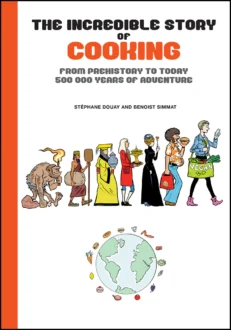
The Incredible Story of Cooking tells the tale chronologically, beginning with prehistoric cuisine among the Homo erectus and Neanderthal leading to our own Homo sapiens.
Fire changes everything, allowing humans to survive on a high-meat diet despite the Ice Age. Years later, cultivation replaces gathering, and herding animals replaces hunting them, allowing for a much more dependable and organized food supply.
Populations grow, cities rise, and technology like clay pottery allows for food storage so that humanity can focus on different things, such as founding civilizations. Each people-group may do it differently, from Sumerians to Egyptians to Chinese to Native Americans, but Douay and Simmat show there is something everyone can agree on: fermentation. Beer and wine may be obvious examples, but time and again different people-groups have focused on fish sauce, an ancestor of to today’s ketchup.
Surprising origins make their appearances throughout The Incredible Story of Cooking, including Egyptians experimenting with yeast in bread, and methods of drying fish leading to techniques of mummification. Simmat and Douay also go into detail on the presentation of food, explaining Confucian traditions for setting Chinese tables and methods of party-planning from Louis XIV still affecting the order in which courses come out.
As worldwide trade pursues not only gold and silks but also the ever-important spices, we see how modern cuisines took root and mingled. The first curry shop opened in England in 1810, decades before the famed fish-and-chips became popular, since it was a matter of importing spices for curry but of improving technology to safely deep-fry in oil – a technique which, by the way, originated from trade with Japan.
Throughout The Incredible Story of Cooking, the reader will meet numerous historical figures they may already know, or who may be new introductions despite a reader having experienced their legacies for a lifetime. The ancient Greek writer Archestratus noted a novel collection of food products, citing the best places to get them as well as recipes for how to prepare them in Gastronomy, which many consider the first cookbook.
Famed humanist Erasmus emphasized good table manners in De Civilitate Morum Puerilium. Philosopher of fine food Jean Anthelme Brillat-Savarin brought deep thinking to eating, saying, “Tell me what you eat, and I’ll tell you who you are.” Perhaps no one made more impact than Antonin Careme, who drew inspiration from architecture for his incredible 19th-century creations that drew from historical and international influences as he served a half-dozen royal houses in Europe and in ways that inspire restaurants to this day.
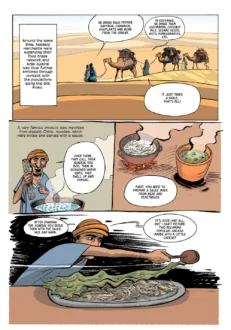
The style of the book is reminiscent of Larry Gonick’s Cartoon History of the Universe, with dense, well-cited information made palatable by fun images and quick jokes. Food is inherently tied in with human history, and the book gives wonderful context in addition to details as it traces just about every major event from the founding of Rome to the Renaissance, and pre-industrial revolutions in Europe to modern industrialization with mammoth food companies, more recently met by the reaction to keep it simple and local. Douay and Simmat go even a step further by providing 22 recipes, from the modern Chicago-style hot dog to the older Chicken Marengo, invented for Napoleon on the battlefield, to ancient maza bread that had fed the people of the Mediterranean for millennia.