 Blogcritics The critical lens on today's culture & entertainment
Yishai Sarid has written realistic novels from the points of view of contemporary Jews: an Israeli army psychologist in Victorious, a scholar who leads youth visits to Holocaust concentration camps in The Memory Monster. These stories engage with the soul, the gristle, the contradictions of the Jewish state as a religiously defined nation in the 21st century, and with those of contemporary Jewish life in general. The Third Temple, Sarid’s third novel to be published in English, dates from 2015, well before the most recent Israeli-Palestinian trauma. And it’s a very different animal – though no less resonant than his tales of verisimilitude.
The Third Temple is a nightmarish, creepily imaginative depiction of an Israel that’s been devastated by a nuclear attack, and has subsequently reverted to a biblical kingdom defined by strict religious practice, notably animal sacrifice. Tel Aviv remains only as a symbol of the “traitorous” secular Jews who lived and partied there until they were wiped out in the “Evaporation.”
The Third Son
Narrating is Jonathan, the deformed youngest son of a war hero-turned charismatic demagogue who rules the land as king. Jonathan helps manage the new Temple, which his father Jehoaz built under purported divine inspiration. The young prince has particular responsibility for spilling a tremendous amount of animal blood (and then feeding hungry priests with the unburned parts of the sacrifices). Indeed old-style religion dominates the society, with naïve Jonathan an avatar of piety. He tells the story from prison after a fresh disaster whose nature becomes clear as the novel progresses.
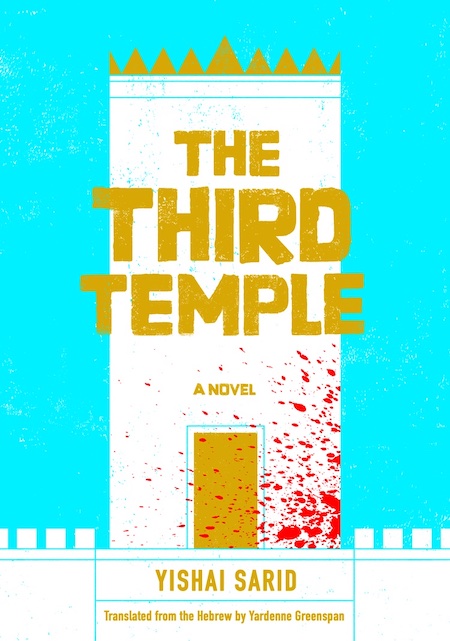
Reading the book is an experience of slow-burn horror, and a particular kind of horror: the horror inherent in religious fundamentalism. In fiction, think The Handmaid’s Tale. In real life, think the Iranian regime with its cruelly violent Morality Police. Now think of such fundamentalism gripping a nation established as a homeland for survivors of a genocide. This version of modern secular Israel is no longer just embattled, but gone, replaced by an ostensibly benevolent but actually oppressive regime propped up by propaganda and cultism.
The Israel of The Third Temple is also surrounded by enemies, referred to in the book not as Arabs and Islamist nations but as Amalekites, the biblical name for the Israelites’ traditional foes. Echoing Orwell’s 1984, reports from the latest war effort bring good news when the real tidings are bad. After the eldest prince returns from battle maimed and near death, Jonathan’s mother, a most reluctant queen, observes the restive populace and tells Jonathan: “The end is near.”
The trouble began when he was made king…They thought that banishing the Amalekites and erecting the new temple meant a return to the days of the bible, and therefore we needed a king. They thought it was the only way the redemption could be complete…We used to have Tel Aviv to balance out the sanctity of Jerusalem…Now that it’s ruined, all we have is mountains. And the mountains are hard.
Again the Walls Come Tumbling Down
As the state edges toward collapse, with starving masses congregating outside the newly built Third Temple, Jonathan tries stubbornly to hold to the new/ancient letter of the priestly law. We know from the beginning that his effort is doomed. But entering his point of view as things fall horribly apart sweeps you along, sometimes almost against your will.
The “real” Third Temple is as yet a dream. The Third Temple reveals how the manifestation of such a dream can prove a nightmare. That’s something that we have observed around the world, and that we would all do well to remember. One starts to feel that Yishai Sarid may be some sort of prophet as well as a fine writer. Translated fluidly and even poetically from the Hebrew by Yardenne Greenspan, the novel is available now from Restless Books.