 Blogcritics The critical lens on today's culture & entertainment
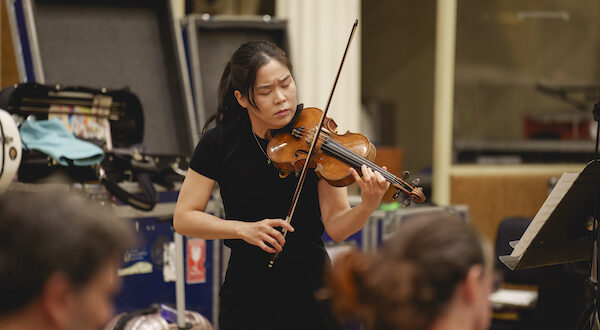
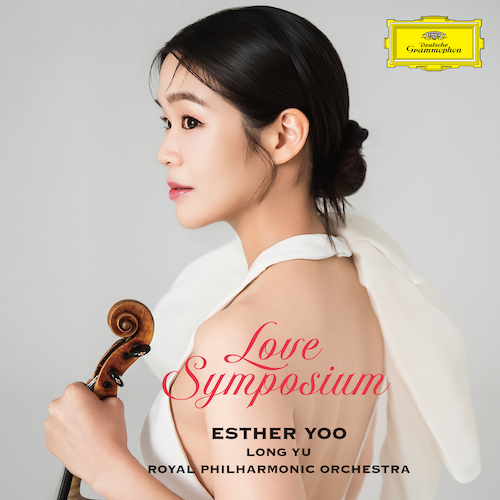
Violinist Esther Yoo made her New York Philharmonic debut back in February 2024 with Leonard Bernstein’s five-movement Serenade. Maybe it was coincidental that Yoo presented this music – inspired by Plato’s Symposium, which explores the different facets of love – in the month of Valentine’s Day. What’s no coincidence is that two Februarys later, in 2026, comes the release of Love Symposium, Yoo’s album with love – and Bernstein’s music – as its centerpiece.
It was with a different orchestra, the Royal Philharmonic Orchestra (RPO), that the London-based violinist embarked on a professional love affair six years earlier, when she had the honor of becoming the RPO’s first Artist-in-Residence. That relationship resulted in the new album, on which the RPO under Maestro Long Yu accompanies Esther Yoo. Love Symposium comes out today, February 12, 2026, on Deutsche Grammophon.
“Creating this album was both a deeply philosophical and emotional endeavor: an exploration of love in its countless forms,” Yoo has said.
I wanted to know more about the genesis of the project.
Yoo told me that she finds Bernstein’s Serenade “endlessly fascinating – both for the music itself and the philosophy behind it.” It was Bernstein’s “deeply emotional response…to Plato’s rigorous philosophical analysis of love. You can hear his own heart and his personal reflections on love woven through the score.”
Serenade had made Yoo’s debut with the New York Philharmonic an especially significant personal milestone. “Playing Bernstein with an orchestra that shares such a profound history and DNA with him was deeply moving. I was also honored to meet his daughter, Jamie Bernstein; her presence and her kindness made the connection to the composer feel even more meaningful.”
Worlds of Love
All this “led me to feel a profound closeness to Bernstein’s world,” Yoo said. Inspired by Bernstein’s music and the source of its inspiration, she “wanted to explore love through both a philosophical lens and a deeply personal one. We often think of love in music as something purely romantic and idealized, but I wanted to create a sound world through an album where we experience love in all its guises: real, honest, complicated, messy, and relatable love.”
For those unfamiliar with the work, I asked the violinist for an example of how Bernstein reflects in his music the different types of love explored in the Symposium.
“The piece itself is a journey,” Yoo said. “Broadly speaking, it mirrors the arc of the dialogue of Plato’s Symposium: starting with intellectual debate in the first movement, moving through myth and scientific inquiry in the middle movements, reaching a state of pure vulnerability in the fourth with Agathon, and finally exploding into celebration in the jazzy finale.
“I find myself most drawn to the fourth movement: Agathon,” she continued. “Agathon portrays Love as something delicate, exquisite, and eternally young. Bernstein captures this through a breathtaking Adagio that for me, is the soul of the entire work. What makes this a perfect example…is how Bernstein chooses to interpret Agathon’s character.
“In the text, Agathon is known for his ornate, flowery rhetoric, but Bernstein replaces that ‘talk’ with absolute sincerity. The textures are so transparent that there is nowhere for the performer to hide. Bernstein finds beauty in the tenderness Agathon described – not through complex words, but through the courage to be still, to be exposed, and to find strength in the quietest moments.”
Salutes to Love
The album includes a number of other works, including the well-known violin features “The Lark Ascending” by Ralph Vaughan Williams and Edward Elgar’s “Salut d’Amour.” More surprising and unusual is the Adagietto from Gustav Mahler’s Symphony No. 5, in a new chamber arrangement by Iain Farrington.
Each selection, for Yoo, represents a different type of love. But the violinist had deeply personal criteria for what music she wanted to include. “I chose repertoire that acted as a landmark in both my musical and personal journey. I wanted to portray pieces that felt intimate to me, yet universal enough for any listener to find their own story within them.”
Specifically, she said, “Works like Elgar’s “Salut d’Amour” and Mahler’s Adagietto are connected to love I have experienced personally. The new arrangement of the Adagietto was inspired by a personal experience that made me see the piece in a completely different light. Because I had developed such an intimate relationship with this movement, I felt compelled to explore a version that reflected that closeness – leading me to this chamber music version.”
As she worked with Farrington on the chamber arrangement, she explained, “it was vital to us that we remain deeply respectful and faithful to Mahler’s original score and intentions. In many ways, this track is the heart of the album: my own love letter expressed through Mahler’s.”
Yoo also wanted to include a piece that reflects the idea of self-love. For that, she turned to Farrington again, who created an arrangement of “Never Enough,” a song from Benj Pasek and Justin Paul’s score for the film The Greatest Showman. “The message is significant: no amount of fame, success, wealth, or external validation can fulfill our innate need for love and genuine connection,” Yoo told me. “It serves as a reminder that while we seek love from others, the most challenging and important work is often cultivating that same love within ourselves.”
Relationships
Yoo’s biography describes her as “uniquely tri-cultural among classical soloists,” having been born in the U.S. and educated in Europe while “proudly embrac[ing] her Korean heritage.” The album reflects this aspect of Yoo’s life and career too, enfolding quintessentially American music like the Bernstein, as well as European masterworks, performed by a storied London orchestra – and led by a distinguished conductor from China.
I asked Yoo about her previous collaborations with the RPO and with Maestro Long Yu, and about recording this album with them.
She talked about what a privilege it is for a musician to build a musical and personal relationship with an orchestra. She and the RPO have shared much since she was appointed their first-ever Artist-in-Residence, touring together and worked together on community outreach projects.
So when it came to recording the album, she said, “Making music with people you know and trust adds a profound layer of depth, trust, and spontaneity to the process.
“It was particularly meaningful to explore the full spectrum of the orchestra for this album – moving from the pieces that involve the grand-scale, full orchestra to the delicate transparency of the chamber music setting.”
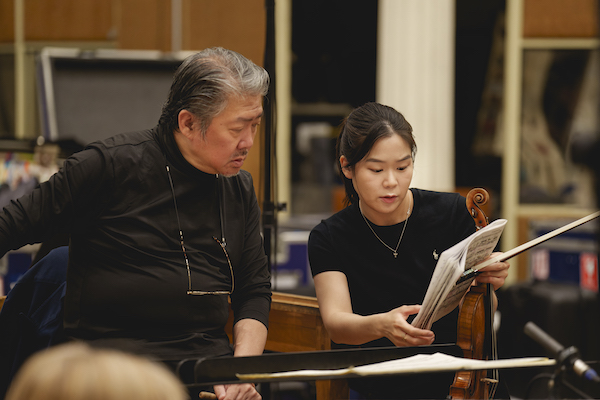
Esther Yoo met Maestro Long Yu several years ago, when they discussed projects that were postponed by the pandemic. “So it was wonderful to finally realize our first performance together for the RPO’s season opening at Cadogan Hall in September 2024,” she said.
“Since that debut, we have performed together with the Shanghai Symphony and China Philharmonic, where he is Music Director. It has been a joy to build this musical partnership with him over the years and I am so grateful for his collaboration on Love Symposium.”
Another important collaborator for Yoo is the 1704 “Prince Obolensky” Stradivari violin. When I asked her about it she responded with exclamation points. “I feel very fortunate to be playing on this wonderful instrument which is on loan to me for several years now – truly my musical partner!”
An International Life
And what about her own international heritage? Has it influenced her approach to repertoire and performance?
“I feel very fortunate to have experienced so many different cultures from an early age,” she said, “and I love living the international life of a traveling musician. This exposure has brought me closer to understanding and relating to composers of all different backgrounds.
“To me, understanding the origins of a piece is vital, so studying the history or having direct encounters with a culture is an essential part of how I approach the music.”
But there have been difficulties too. “While being tri-cultural is a gift, I struggled for a long time with the question of identity. For many years, I felt like I could fit in everywhere but belonged nowhere. I had to go on a real journey of self-discovery to realize that my anchor is within myself.
“That realization has given me so much strength and helped me be more accepting of my authentic self, which in turn brought more authenticity and conviction to my music-making.”
Paying It Forward
In parallel with this self-discovery, Yoo has manifested a generosity of spirit. It is reflected in part in a series of practice-tips videos she recorded for her YouTube channel, where she comes across as a natural instructor. In 2014 she became a Professor of violin at the Royal College of Music (RCM) in London.
I asked her something I often ask of performing artists who also teach: How does she plan to integrate her new, more formal educational duties with her performing career?
“It was a true honor to be offered the position at the Royal College of Music,” she said, “especially given that I was once a student there myself! My commitment to my performance career remains as strong as ever, and I am excited to pursue my role at the RCM in parallel.
“Thankfully, RCM is incredibly supportive of my performing schedule, and I find the inspiration really goes both ways.” On the one hand, “it is valuable for the students to see their teacher actively engaging with the professional artistic world.” On the other, “I find that teaching reinvigorates my own playing. It keeps me curious and constantly questioning the ‘why’ behind the music. So far, balancing the two has been an incredibly rewarding and energizing experience.”
Similarly, Esther Yoo believes Love Symposium will be rewarding and energizing for listeners. The album’s theme of love is not just a concept. It embodies still another aspect of the generosity of spirit that Yoo brings to her virtuosic excellence.
Love Symposium is out today.