 Blogcritics The critical lens on today's culture & entertainment

The Picture of Dorian Gray
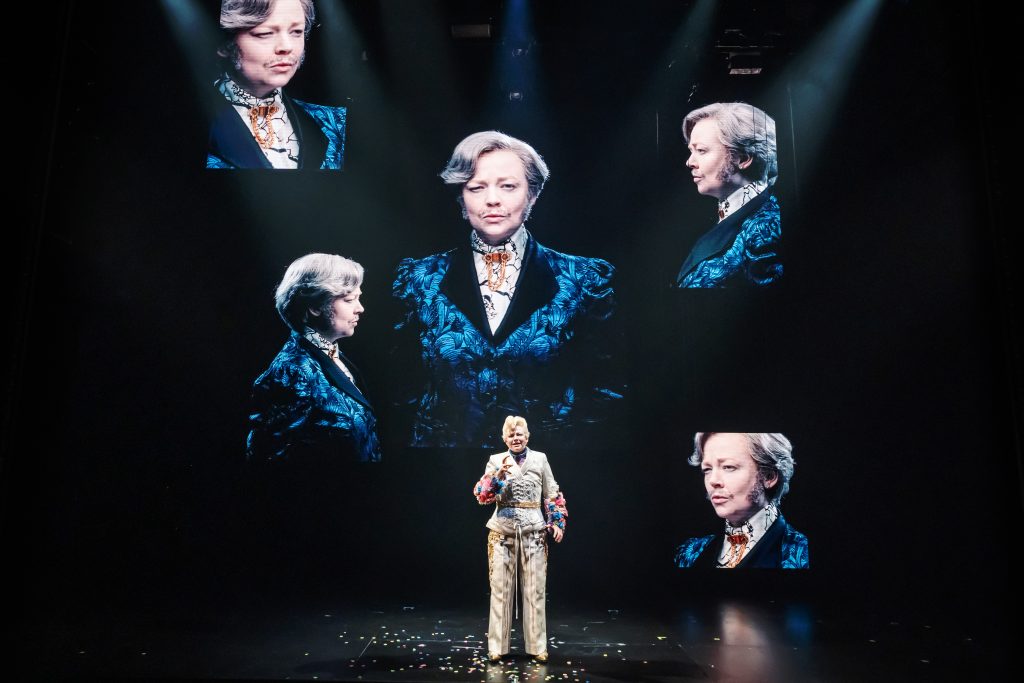
Emmy and Golden Globe Award winner for her role as Shiv in Succession, Sarah Snook makes her debut exploding out of the Broadway gate with her shattering, one-woman, whirlwind performance of Dorian Gray. Donning 26 roles, she gives twenty-six performances, all of them profoundly realized with changes in costume, hair, voice, posture, gait, accent and facial expression, subtly captured on camera, four cameras with six screen viewpoints to be exact. Snook’s anointed presence captivates in the marvelous, technically ground-breaking production of Kip Williams’ Oscar Wilde adapted novel, The Picture of Dorian Gray.
Because of audience enthusiasm, The Picture of Dorian Gray at The Music Box now extends an extra two weeks through June 29th. What a glorious must-see, especially for Snook’s bravura performances that require prodigious stamina, pacing, and focus. She won an Olivier Award for her performance last year. The innovative use of camera angles, close-ups, medium shots, establishing shots, and strategic reversions to prerecording followed by returns to live stage action all work to create an enthralling entertainment.
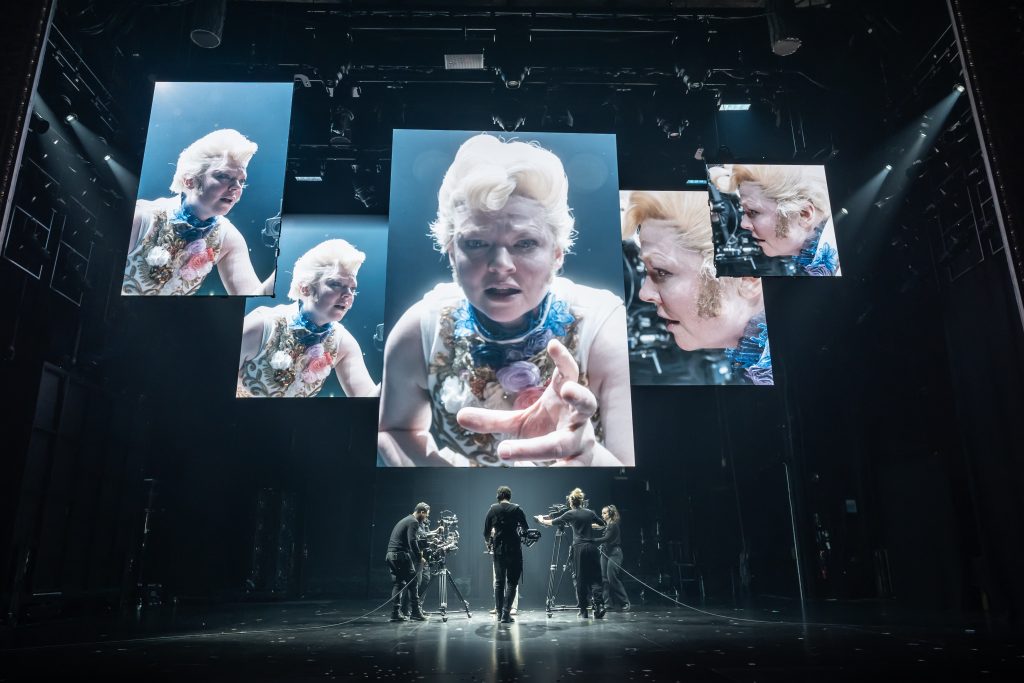
The Picture of Dorian Gray presents as “cine theater”
Identified as “cine theater,” the production requires perfectly coordinated teamwork. The amazing team who centralizes Snook’s characters, live streams their authenticity with acute, seamless precision in a spectacularly timed choreography that engages throughout. For its innovation alone the production must be seen and appreciated. It defies description. In fact, one might see it a few times to glean the profound turning points and digressions of character as Snook infuses Dorian Gray with a sleek insidiousness and snark that is undefinable, moment to moment.
Kip Williams’ direction of Dorian Gray
As director and adapter of Wilde’s gothic, philosophical novel, Williams honors Wilde’s themes as he stylistically moves between Victorian England and the present, as the team dresses Snook in wigs, corsets, cloaks, and other accoutrements reflecting the setting. With references to the timelessness of human frailty found in the key characters, Williams and Snook make the production sardonically and thematically current.
Williams’ phenomenal vision, enhanced by his team of videographers, propels us into the interior of Snook’s Dorian Gray with a variety of cinematic screen shots from close-ups, to extreme close-ups, to medium shots. Cleverly evoked by Marg Horwell’s scenic and costume design, Nick Schlieper’s lighting design and David Bergman’s video design, Snook heightens the battle of Dorian Gray’s soul conflict between his contrasting impulses of good and evil.
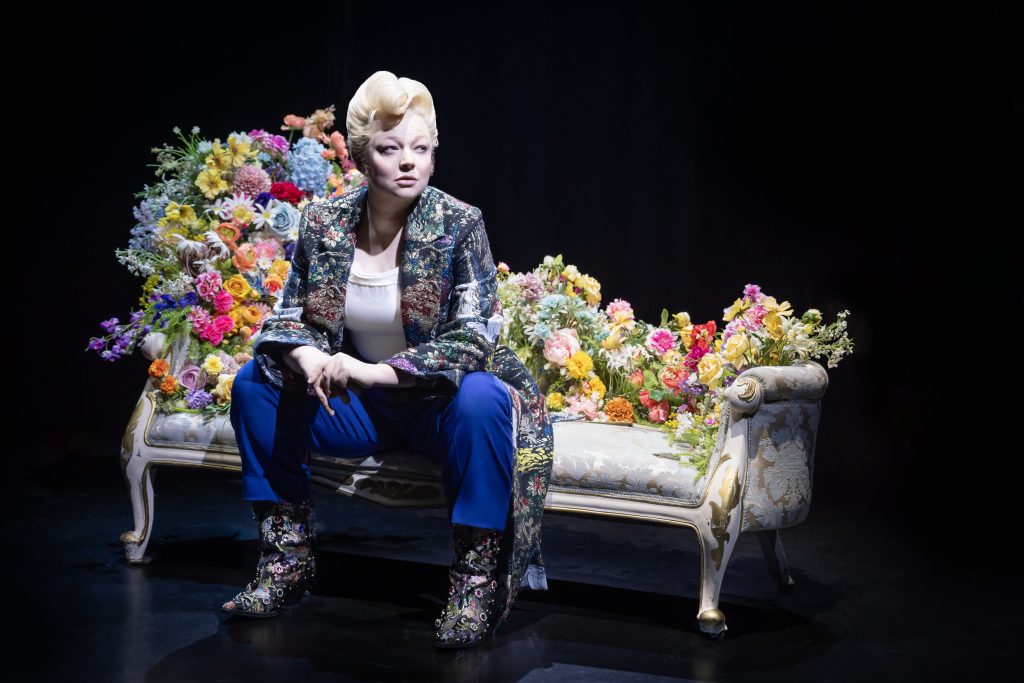
The Picture of Dorian Gray is filled with Snook’s irony
Snook’s narrator makes the audience her confidante to Dorian’s demise. Thus, with theatrical flourish and irony, Snook displays the permutations of Dorian Gray’s devolution from innocence and angelic purity to grotesquely monstrous evil that manifests on blow ups of a phone screen courtesy of distorting filters. We note all the nuances and increasing self-destruction via Kips’ film portraiture, live streaming and contrasting live stage action.
Wilde’s themes take new measure and grace. The key thrust of Snook’s Dorian brings us to the suicidal consequences of his hedonistic pursuit in a warped mind/body synergy. Dorian’s internal circumstances intensify with hope, guilt, and fear. With devastating results, he covers up his sins, especially when he commits murder. Finally and completely, the revelation of Dorian’s inevitable demise hypnotizes, terrifies, but entertains. This masterwork compels us to laugh, yet look inward and around at the narcissists and vainglorious, who trap themselves in the folly of worshiping external beauty. It exposes the ridiculousness of others who act amorally with impunity while ignoring conscience until too late, they destroy themselves.
Williams and Snook transform and enliven the novel’s brilliance
Based on Oscar Wilde’s 1890 novel, the story follows Dorian Gray, an innocent young man, whose beauty is immortalized in a portrait. Wilde originated the idea after an artist painted his own portrait, and Wilde remarked the shame of his aging while the portrait captured his youth remaining static in time. Wilde exclaimed he wished it might be the reverse, that the painting aged while he remained fixed in the glory of youth. Thus, he birthed the conceit upon which the novel and this ingenious adaptation flourishes.
Of course Wilde, perhaps cleverly referencing Christopher Marlow’s Doctor Faustus’ bargain with the Devil, has Dorian do the same. In front of his two friends, the painter Basil Hallward and Lord Henry Wotton, Dorian make his fateful wish/prayer that he would give his soul to remain as young and beautiful as his picture.
A pivotal scene between Lord Henry, Dorian, Basil
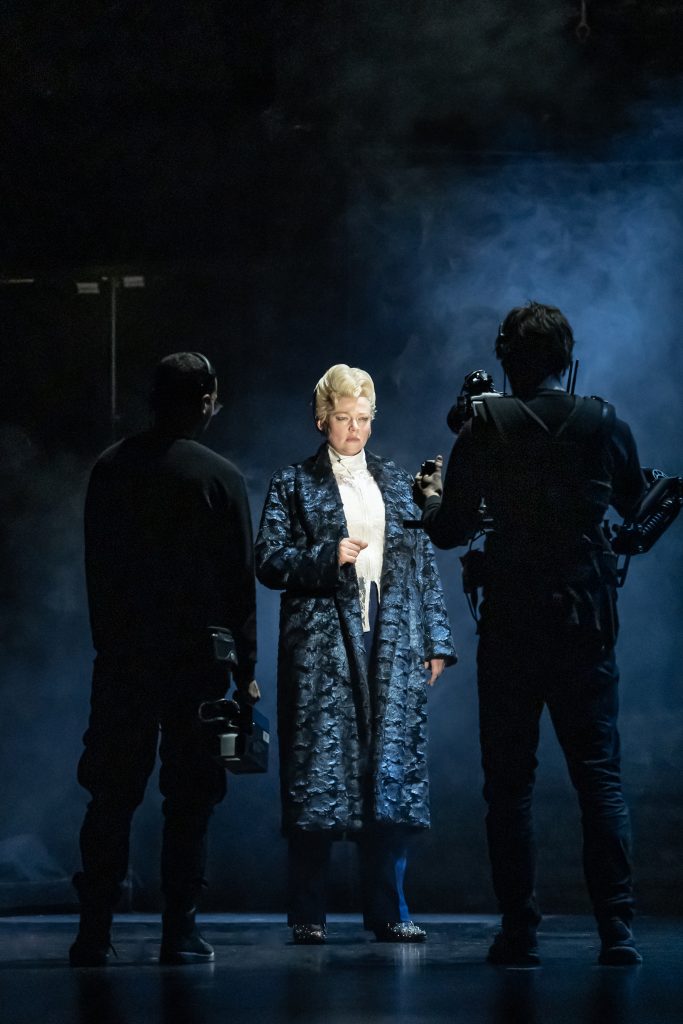
In this pivotal scene Williams has pre-recorded Snook’s sly, winking Lord Henry and the hirsute Basil Hallward, who together, unwittingly tempt Dorian toward the symbolic transference of his soul to the picture. Basil states he would rather stay with the “real” Dorian, referencing his extraordinary artistry, rather then go to the theater with Lord Henry and Dorian. In Basil’s insistence that he has painted Dorian’s “reality,” the magic happens. Basil endows the portrait with soul life. At that turning point Dorian sees his beauty anew and affirms for himself that aging will make him hideous and horrible. Thus, he makes his choice to defy the natural order of things and worship youth and beauty in exchange for the goodness in his soul.
From this turning point on, Dorian lives out Lord Henry’s suggestion to indulge his senses with the abundance of all that life offers. As he enjoys every whim (the dialogue references certain sexual acts as in the novel), he notes the parallel between his youthful beauty and the growing ugliness of the picture. This fact Dorian hides from his friends.
As Dorian grows older, his face remains youthful and untouched, but the portrait becomes horrid and grotesque, representing the corruption of his soul and the consequences of his hedonistic lifestyle. However, Williams reveals Dorian’s maturity with his sophisticated clothing and up swept hairstyles, all of which reflect a modern present. With this ingenious development, Williams prepares the audience for the use of the small phone screen and filters to expose Dorian’s warped soul bloated with the burden of his sins and amoral living, which includes covering up murder.
The fascinating conclusion of The Picture of Dorian Gray
In a fascinating conclusion, Snook’s Dorian forgets his connection with the picture, so fragmented he is from himself and the consequences of his actions. As a result his final, destructive act to rid himself of the consequences of his soul sickness shocks. Thanks to Snook’s intensity as Dorian, we realize the import of Dorian’s last action as Snook’s Dorian realizes it, too late. What a revelatory moment! It leaves us without emotion or empathy for the character. We metaphorically die with him.
This marvelous production transforms into a keen relevance for our time. One thinks of Donald Trump, then realizes that Wilde’s character has more of a sense of accountability and guilt mirrored in the portrait of his soul than Trump admits to. As Dorian attempts to become good and erase the past, he fails. Dorian destroys himself. He pays the ultimate price and realizes he gets away with nothing. Instead, in leveraging his soul’s former purity, he loses the only thing of true value and importance in life. The rest is dross.
Wilde’s theme that we cannot escape our ill deeds, better to not do them, hails with hope for our time, especially when we see the wicked “walk between the raindrops” with impunity. This production of The Picture of Dorian Gray uplifts that a reckoning does come to the lawless, and it often shocks those who witness it.
Kudos to those already mentioned with additional reference to Clemence Williams’ (composer and sound design), well integrated and atmospheric composition. The Picture of Dorian Gray runs two hours with no intermission at The Music Box, 239 West 45th St between 7th and 8th. https://doriangrayplay.com/tickets/?gad_source=1