 Blogcritics The critical lens on today's culture & entertainment
Bughouse
An unknown for almost his whole life, the incredible outsider artist and epic novelist Henry Darger (1892-1973) comes alive at the Vineyard Theatre in the multimedia work Bughouse. Adapted from Darger’s writings, Pulitzer Prize-winning playwright Beth Henley’s 70-minute play enthralls. With direction by Drama Desk and Obie Award winner Martha Clarke with sharp conceptualizations of Darger’s life and art, the production reveals Clarke’s fine efforts.
The dance-theater director’s prodigious talents shine. Incisively, Clarke shepherds Obie Award-winning performance artist John Kelly to spin Henry Darger’s creative angst into the fantastical in this beautiful and poignant production. As the play has been heartily embraced by audiences, the producers have extended Bughouse through April 5, 2026.
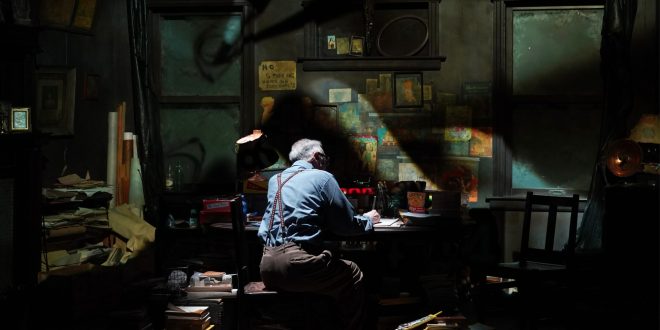
Clarke uses Ruth Lingford’s animation, John Narun’s projection design and Fred Murphy’s cinematography to create the layered realities of Darger’s exterior and interior worlds. She uses animations created from Darger’s illustrations to explore and enhance Darger’s life and work. When projected on windows and mirrors, these “unreal realms” live.
John Kelly Becomes Henry Darger
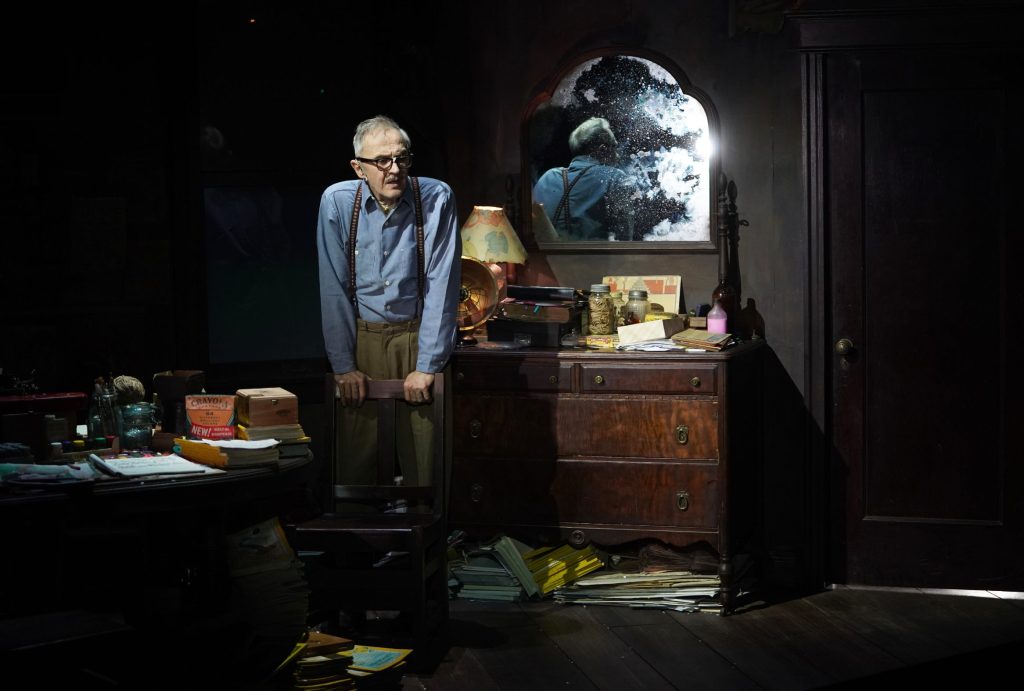
Kelly’s Darger moves seamlessly through the artist’s interior states of consciousness with enthusiasm and feeling. We can’t help but identify with the artist’s uniquely metaphoric creations. These include depictions of archetypal battles between good and evil. Learning of Darger’s childhood experiences, one can conclude that the battles express emotional conflicts from his past that he could reconcile only through his artistic creations.
Inspired by photographs of Darger’s apartment, Neil Patel’s set has Darger living and creating in a claustrophobic, curio- and antique-stuffed space. In Patel’s recreation, Darger hordes National Geographics and period magazines in piles on the floor. Various items crowd every inch of space in the room. Papers and illustrations cover the table where Darger types up his magnum opus, a few lines of which Kelly’s Darger reads as he types.
Darger’s Protagonists: The Vivian Girls
Henley aptly uses passages from Darger’s epic fantasy (“The Vivian Girls, fought bravely against the Christian hating, child slave holding Glandelinian demons”). The audience becomes Darger’s confidante as we watch his creative process unfold. When he explains his life story, his imagination sparks. Immediately, he moves to type up the continuing adventures of the Vivian Girls, his chief protagonists. “The Vivian Girls…were prettier than fairies and as good as saints and though delicate in form as they looked, they were perfectly strong.”
In their perfection, his characters fight battles in righteousness, overcoming oppression and brutality. Darger explains what makes them heroic when he says, “Beautiful as they were in features however, they were more beautiful in soul doing all that all good children should do, and were so righteous and attended church so frequently every day that their father began to look upon them as saints!”

An Oppressed Childhood
Sharing his woeful childhood after his mother died and his father could no long care for him, Darger expresses his hatred of the abuse he experienced as a child. Sadly, the nuns in the school he attended, “Mission of Our Lady of Mercy,” persecuted him. Likewise, the caretaker at an asylum for feebleminded children, where he lived until he finally escaped after two failed attempts, bullied and abused him. Clearly, Darger appeared and behaved differently from others.
Based on various reports and his examination, a doctor misdiagnosed him as feebleminded when, in fact, the opposite was true. Henry’s father had taught him to read at a very young age so he could read the newspaper to him.
We question why these incompetent individuals didn’t recognize or encourage Darger’s talents. Still, the soul and psyche of the reclusive hospital janitor and dishwasher Henry Darger experienced trials that strengthened him. And this strength sustained and nurtured Darger’s artistic essence, acutely and specifically portrayed by John Kelly in this fine production. If one believes the adage that pain and suffering produce the artistic drive to express an artist and writer’s soul’s agonies, then Darger surely is representative.
Thankfully, Darger’s incredible imagination and genius lives on in 350 exquisite watercolors which appear in museums, galleries and collections worldwide. His fantasy novel of 15,000 pages, his 5,000-page autobiography and more are available to read.
A Caveat About Darger’s Work
Darger’s illustrations sometimes depict harm against children, as his heroines battle to free enslaved children against evil forces. Also, some of the illustrations depict children without clothes. Bughouse includes a few of these images.
Bughouse runs 70 minutes with no intermission at the Vineyard Theatre until April 5, 2026.