 Blogcritics The critical lens on today's culture & entertainment

English
In Sanaz Toossi’s Pulitzer-Prize winning play English, currently on Broadway at the Todd Haimes Theatre, the playwright highlights how our language defines us. Thematically, Toossi’s play raises many questions about language’s impact. For example, from one language to the next, names translate into alternative meanings, connotations, and images. Indeed, some individuals change their names to evoke a different self. Considering the import of the language we speak and our identification with it, Toossi reveals how learning a new language may impact the way we understand and perceive ourselves and others.
Starring an all-Iranian cast, the play premiered off-Broadway at The Atlantic Theater Company. Astutely directed by Knud Adams, its popular audience reception and Pulitzer Prize grounded its transfer to Broadway in a limited engagement until March 2nd.
Interestingly, Toossi sets up an English classroom in Iran (Marsha Ginsberg’s design), for her investigations into language’s impact. Populating her play with an Iranian teacher and four Iranian students, we watch the comedy and drama as the characters grapple with learning the non-poetic, “ungainly” language.
English takes place in Karaj, Iran
The setting is Karaj, Iran in 2008 before and during a confluence of events taking place between Iran, the United States, and other English-speaking countries. At the time, immigration is fairly easy and Iranians on the move want to study abroad, do business, and travel for extended stays to English-speaking countries to which their families emigrated.
Marjan (Marjan Neshat), teaches for the TOEFL, the Test of English as a Foreign Language. The standardized, timed test measures the English language ability of non-native speakers who wish to study abroad in English-speaking universities. Accepted by more than 11,000 universities and other institutions in over 190 countries, the test gauges students’ working knowledge of English. Thus, their passing score indicates the probability of their success, not only in their classes, but also in navigating the culture and society.
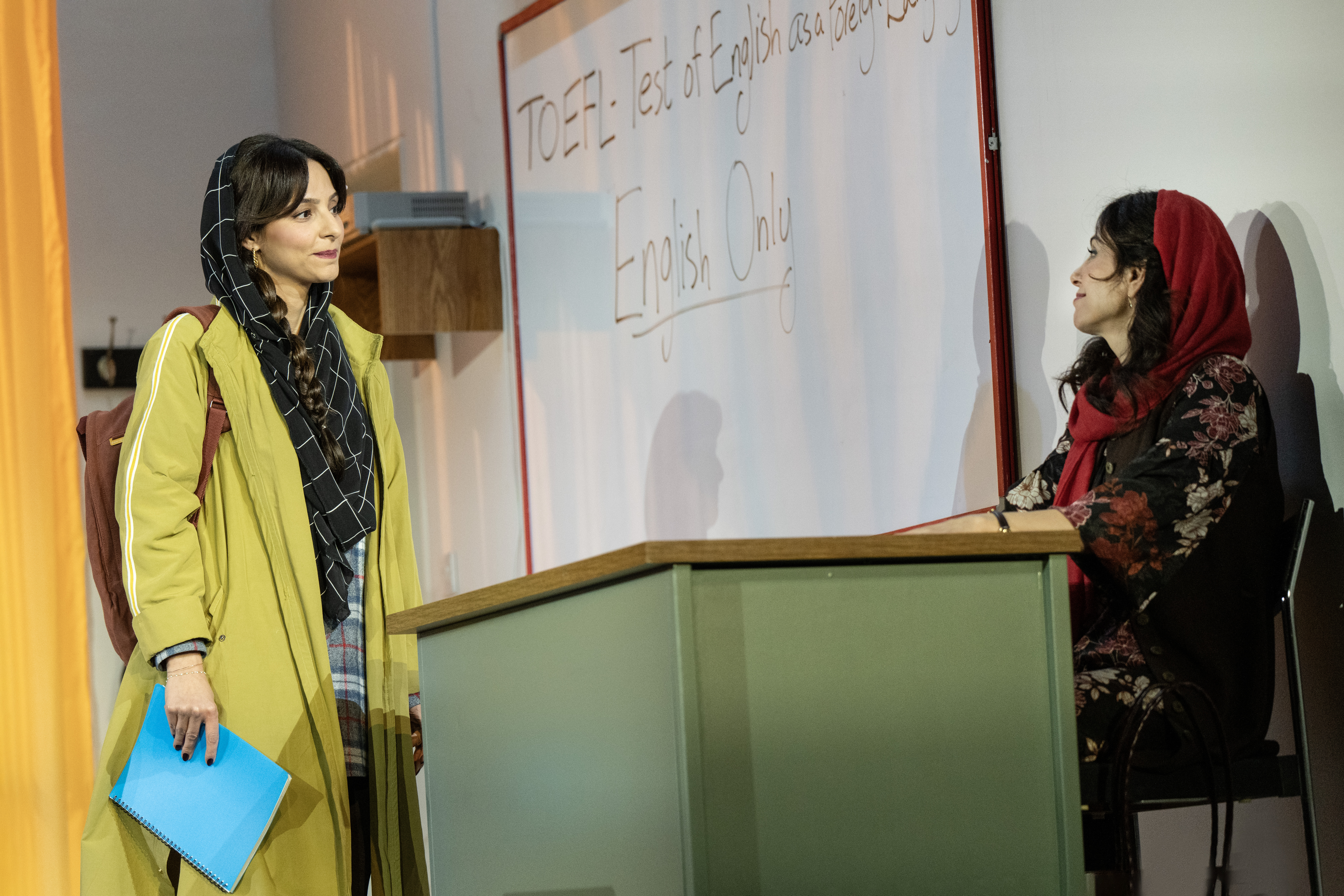
In English, everyone learns, especially the teacher, Marjan
As Neshat’s Marjan teaches, she realizes the unique class dynamic that skews her instruction’s success with her diverse students. Personalities emerge. Though she attempts to be objective, she finds herself aligning with students who demonstrate like-minded abilities and cognition. As her students reveal themselves in their response to her and language-leaning, we find their observations humorous. Toossi with Adams’ directorial vision keeps the action lively with “show and tell.” Other games make the students’ actions and interactions delightful and engaging.
Importantly, conflict arises and escalates when the struggling and embarrassed students project onto Marjan the onerous time they have with learning a completely different mode and thought process of communication. Authentic in her portrayal as Marjan, Neshat acutely reveals her character’s inner emotional struggle with Elham (the feisty Tala Ashe). Indeed, when Elham repeatedly challenges her, their sub rosa differences rise to the surface. Not surprisingly, Elham accuses Marjan of not liking her. Ironically, the accusation appears to stick until the last half of the play when the playwright pulls the rug out from under us. Toossi employs effective misdirection of plot and characterization until her revelations at the conclusion.
English’s comedy evolves organically
Humor evolves organically from the students’ perceptions, struggles and slippage into their native tongue Farsi in the first weeks of the class. An excellent teacher, Marjan attempts to gradually curb their fear and angst by encouraging the students’ competitiveness during games. Gradually intensifying the class difficulty, eventually she requires they only speak English. If they lapse into Farsi, she gives them a demerit. Enough demerits removes them from class. Marjan’s skills are effective but troublesome for the students.
The actors speak English throughout. Either they speak haltingly, struggling to learn, or they rip off sentences quickly (in English), which indicates they speak easily in their mother tongue.
Initially, Marjan tries to show equanimity among Omid (the attractive Hadi Tabbal), Elham (the excellent Tala Ashe), the shy Goli (the sweet Ava Lalezarzadeh), and the aloof Roya (the heartfelt Pooya Mohseni). However, it becomes apparent that Tabbal’s Omid, the only male in the class, gains her favor. Omid speaks near perfect, unaccented English. Marjan connects with him cognitively and on a more personal level, which Elham insinuates means something more. Suggestively, Neshat and Tabbal effect an intriguing bond that flows with undercurrents between their characters.
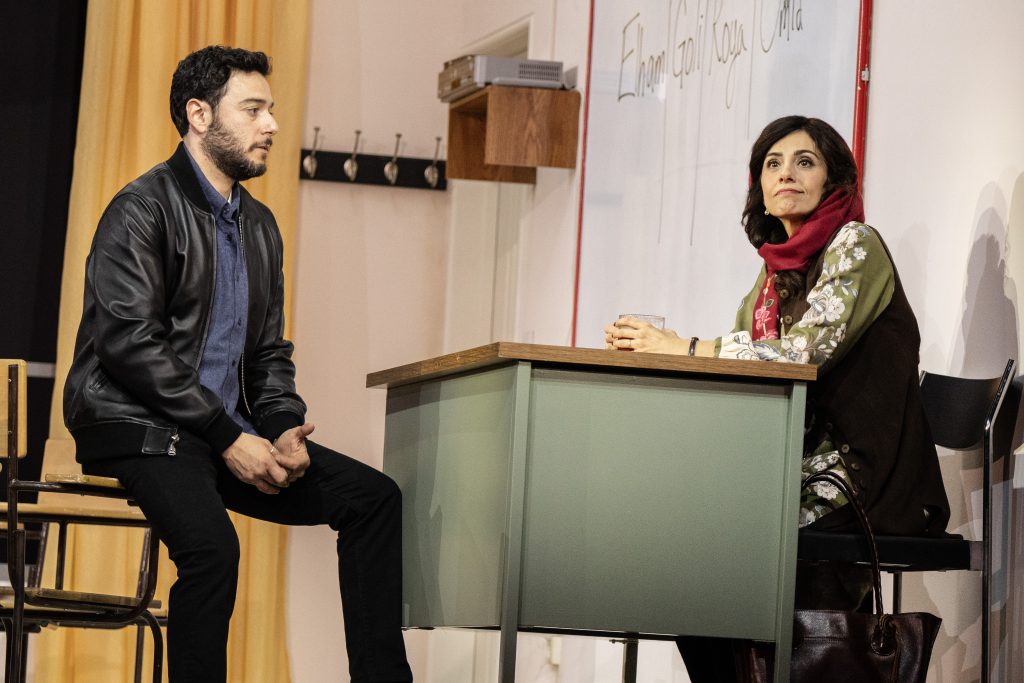
Toossi develops themes through characterization
Toossi uses her characterizations to organically develop her themes. These strengthen our involvement and pull at our heart strings. Thus, when Omid’s mystery is revealed or when Elham comes back to discuss how she performed on the TOEFL, we identify. Most of all, Toossi has accomplished a milestone by indicating the importance for native speakers to stand in the shoes of immigrants who struggle with our language.
We comprehend this when Marjan forces her students to speak only English. Of course they fall back into Farsi to communicate. Clearly, this begins to wear down the teacher and the students who must converse fluidly as they approach thinking as a native English speaker. All of them chafe at the difficulty. Especially they feel the pain when Neshat’s Marjan “censures” their reversion to Farsi by noting it publicly on the chalkboard to embarrass them. The only one who appears confident as a fluid speaker is Tabbal’s Omid. In the last half of the play, Toossi reveals the secret of Omid’s facility.
Emphatically, Toossi affirms the courage and heroism required to learn a different language. She implies it requires a willingness to expand to another identity, another thought process, a way of being. Ultimately, the language’s formation and structure changes the individual emotionally, mentally, psychologically. This must not be underestimated. All of the actors’ portrayals vitally heighten this theme and bring us toward the importance of empathy. Ashe’s exceptional development of her character compels us to identify with Elham whose success on the TOEFL brought audience applause the night I saw the production.
In English, not all Marjan’s students succeed
On the other hand, we feel for Roya’s failure to succeed. Continually, she comes in last in the competitive games. We discover Mohseni’s Roya resents being pressured by her son to learn the ugly language. Indeed, she takes the class reluctantly because her son wants his mother to speak to her Canadian granddaughter, eschewing Farsi. Sadly, for Roya, her son uplifts Canadian traditions to fit in as a resident. When she discusses her son’s email in Farsi and a voice mail he leaves in English, she notes the beauty of Farsi. She labels the sounds he makes speaking English harsh, removed, and cold. She asks the class, “Who is mom? I am Maman.” For Roya, in the word “mom,” the history of Persia is eradicated.
The profound distinction provokes the audience to understand language learners. It may seem extreme, but Toossi suggests they sacrifice their native country’s culture and history. Roya’s revised relationship to her son and granddaughter, separated more by the nature of the language she must speak than the distance from Canada to Iran, breaks her heart. The geographical difference matters little. However, her son’s adoption of this new way of being speaking English reveals he doesn’t venerate his birth culture, whose ancient past he rejects daily.

Marjan avoids discussing why Roya leaves class
Unable to overcome her resentment at having to learn the harsh, unpoetic words, Roya accepts failure. Indeed, she refuses to transform her traditional ways of thinking by learning an unfamiliar language structure and strange, ugly words. Symbolically, she believes that this learning would change her closeness with her culture, and her way of being. It would be a slow death. Thus, without further explanation or saying goodbye to the others, Roya leaves the class. The sacrifice is too great for her to be reborn into a culture that reshapes her identity and disappears her former Farsi self.
Normally empathetic, Marjan moves on to “save” the others and never tries to help Roya adjust. Though the others question Roya’s disappearance, Marjan refuses to discuss the matter. Thus, the undercurrent of her own feelings of failure with Roya clarifies. However, the other students realize that Roya left unhappy and dissatisfied and subtly hold Marjan responsible with their questions.
Toossi’s choice in characterizing Marjan
Toossi makes an important choice not to easily reveal the puzzling Marjan’s behavior. Why didn’t she use Roya’s difficulty as a teachable moment? Why didn’t she encourage her or the others or explore for a few minutes a path to enhance their own understanding? Toossi never indicates the extent Marjan empathizes with Roya’s rebellion and resentment having to speak English. The playwright never answers the questions because the mystery hints at Marjan’s complicated emotions and feelings. Indeed, Roya has taught Marjan, who loves English, that there are losses to learning it. Interestingly, it is a new revelation that Marjan doesn’t deal with.
Losses vs. gains
Toossi’s strongest moments present themes of loss. Principally, the loss of the old identity, and an incomplete adoption of a new English identity threads throughout the play. Omid expresses his discomfort living in the gap between cultures, not feeling at home in either one. For each of the characters, we understand that speaking English is like being birthed again. Language-learning reverts them back to their childhood. Indeed, this sacrifice humiliates them, as does their difficulty fitting in speaking the harsh English sounds. For example in the United States, their thick accent seems tantamount to a “war crime,” Elham humorously and ironically suggests.
The playwright covers a great deal of ground in her touching play, which ends on a high note. We finally hear the actors speak Farsi.
In its transfer to Broadway, a few of the production’s problems remain. Some of the actors couldn’t be heard, even by those sitting close to the stage. Actors needed to project their voices for the larger theater. Also, the set construction, a suggested classroom on a platform turntable, muffled the sound at times. Though an ingenious, symbolic idea, its execution should have enhanced the production, not made it more difficult to enjoy.
Finally, the arrangement of the chairs down front occluded the sight lines in certain areas of the audience. Unless the audience hears each line of the actors and sees all areas of the stage without obstruction, the production is impaired. This is too marvelous a work for it not to be technically spot-on.
English is in a limited engagement until March 2 and runs one hour forty minutes with no intermission at the Todd Haimes Theatre. This excellently acted Roundabout Theatre Company production is on 227 West 42nd Street between 7th and 8th. Don’t miss it. https://www.roundabouttheatre.org/get-tickets/2024-2025/english