 Blogcritics The critical lens on today's culture & entertainment

Archduke
What is taught in history books about World War I usually references Gavrilo Princip as the spark that ignited the “war to end all wars.” Princip and other nationalist/anarchist Bosnian Serbs, who were devoted to the cause of freeing Serbia from the Austro-Hungarian empire, assassinated the Archduke Franz Ferdinand and Duchess of Austria-Hungary.
They succeeded in this after making mistakes that nearly botched their mission. What might have happened if they hadn’t murdered the royals? Rajiv Joseph’s play Archduke offers a “What if?” It’s a profound question, not to be underestimated.
In the sardonic comedy Archduke, Joseph (Bengal Tiger at the Baghdad Zoo) has fun with this historical moment, fictionalizing what some scholars think about the conspiracy. They have suggested that Serbian military officer Dragutin “Apis” Dimitrijevic (portrayed exceptionally by Patrick Page) helped organize the conspiracy behind the assassination.
The play is about how youths become the pawns of elites as they commit violence and create chaos. It’s at Roundabout’s Laura Pels Theater until December 21, 2025.
A Dark Farce
Archduke propels its characters with dark flourishes. The playwright re-imagines the backstory leading to the cataclysmic assassination. Franz Ferdinand’s murder touched off the war, ultimately changing the map of Europe in the aftermath of the bloodiest war in history up to that time. Joseph mixes facts – names, people, dates, places – with fiction – dialogue, made-up incidents, and idiosyncratic characterizations. For example, he has the character Sladjana (Kristine Nielsen) in a chapel offering the young men “cherries” in brandy, which are actually kitten hearts. Employing revisionist history he aligns his theme with our current time. Then, as now, sinister, powerful forces radicalize desperate young men to murder for the sake of political agendas.
In order to convey his ideas Joseph compresses the time of the radicalization for dramatic purposes. He laces the characterizations and events with dark humor, action, and sometimes bloodcurdling descriptions of violence.
Page’s Captain Glorifies Political Violence
Captain Dragutin “Apis” Dimitrijevic’s mesmerizing account of a regicide he committed in June 1903, for which he becomes a Serbian hero, is an example. Mentoring the young men, he acutely describes the act (which included disemboweling). He emphasizes the killing with specificity, instructing the young men he mentors. Then he relates dramatically how security shot him three times and the bullets remain lodged in his body. Page delivers the speech with power, nuance and grit. Just terrific.
Dimitrijevic’s taking of those three bullets fits with historical references. The Captain relates his act of heroism to Gavrilo (the winsome, affecting Jake Berne), Nedeljko (the fiesty Jason Sanchez), and Trifko (the fine Adrien Rolet) to inspire them to go to Sarajevo and kill the Archduke and Duchess. The playwright teases the audience by placing factual clues throughout the play.
A Pleasure for History Buffs
History aficionados will enjoy Archduke. Others will find the fight sequences and Kristine Nielsen’s slapstick humor and perfect timing fun. They will listen raptly to the Captain’s fervent story and consider his slick manipulations. Director Darko Tresnjak (A Gentleman’s Guide to Love and Murder) shepherds the scenes carefully. The production and all its artistic elements benefit from his coherent vision, superb pacing and smart staging. The set, by Alexander Dodge, with Linda Cho’s costumes, Matthew Richards’ lighting, and Jane Shaw’s sound design aptly fit Tresnjak’s vision.
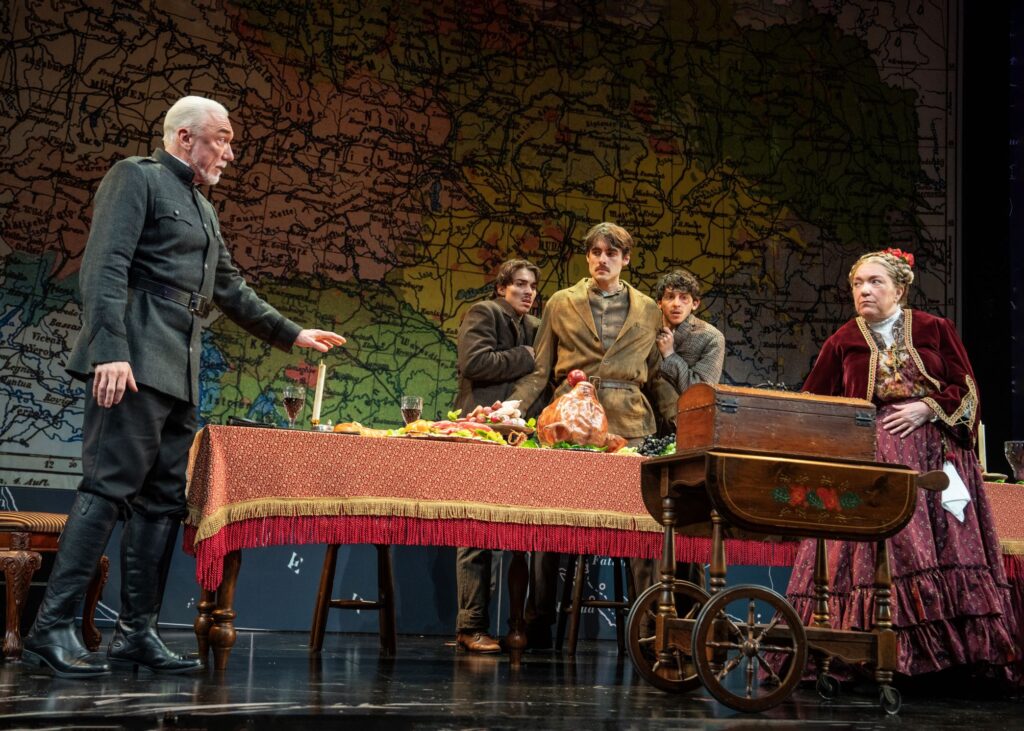
In Joseph’s fictionalized telling, before the Captain’s big speech of glory and violence, he has Nielsen’s cook stuff the starving, tubercular teens with a sumptuous feast. As they eat, he provides his history lessons using a pointer and an expansive map of the empire. Like obedient lapdogs they agree with him when he tells them to, swallowing his stories as they fill their bellies.
Easy Prey for Political Conspirators
How did these young men get there? The first scene takes place in a warehouse and shows how young men begin to become the dupes of those like the charming, well-connected Captain Dimitrijevic. We understand that a secret cabal is cultivating and entrapping desperate, dying young men. In real life Captain Dimitrijevic and Gavrilo belonged to a secret society called the Black Hand. The playwright ironically hints at these ties when the Captain gives Gavrilo and the others black gloves.
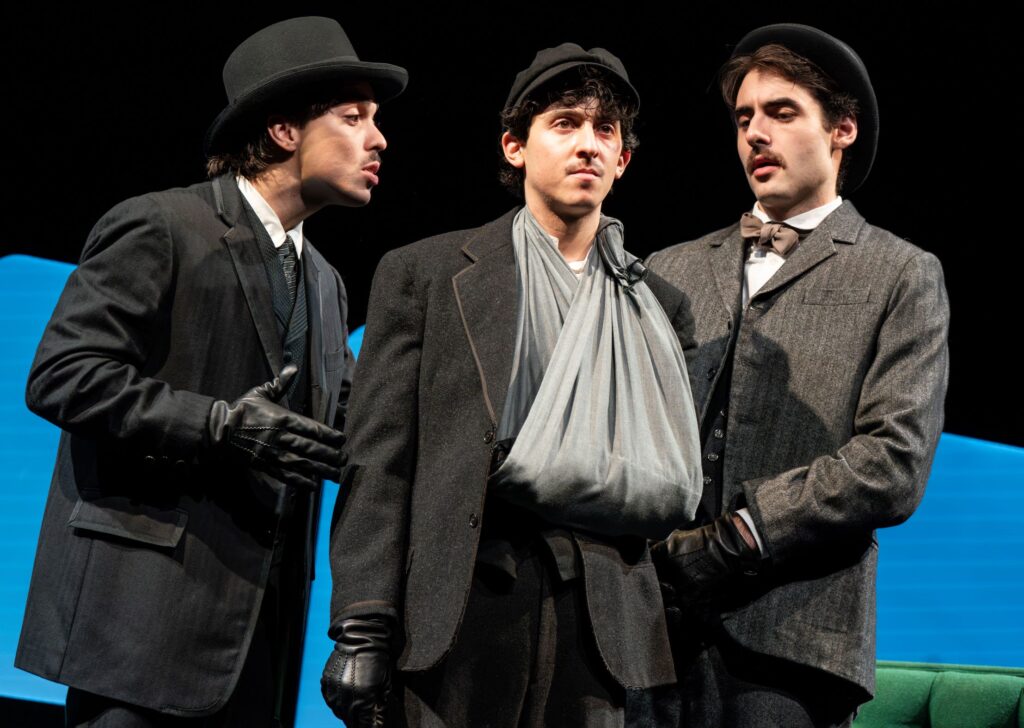
In the warehouse scene the soulful and dynamic interaction between Berne’s Gavrilo and Sanchez’s Nedeljko evokes empathy. Society ignores these hapless, tubercular innocents, treating them as insignificant refuse, ready for exploitation. Poverty, tuberculosis, lack of education, and hunger bring them to a conspiratorial doctor who offers to help them free of charge. Instead of curing them, the doctor sets them up with a “guy” (Trifko) who lures them to the Captain’s home for a good meal from a “lady cook.”
They go because they are starving and “have nothing to lose.” The cook, Sladjana, played by the always riotous Kristine Nielsen, provides a good deal of the humor during the Captain’s history lessons. The radicalization of the teens revolves around the feast, the sweets, and her “special boxes” filled with surprises. Nielsen’s antics ground Archduke in farce; the scenes with her are eminently entertaining as she revels in the ridiculous.
Manipulating to Kill
The vibrantly sinister Captain seduces the young men by spinning polemic like a magician with convincing prestidigitation. His ability to persuade them resonates with today’s media propaganda that persuades people using generalizations and lies of omission. The more needy the individuals are, emotionally, physically, and psychologically, the more susceptible they are. And the more desperate they are, the less they have to lose by martyring themselves and thus, they believe, obtaining glory and remembrance.
Joseph makes the interesting point that their culture abandons the teens as so much flotsam and jetsam. The play suggests that if we don’t take care of our youth but leave them to their own devices, they will take care of us with political violence, structured by those most likely to gain. Cui bono? Those pulling the strings receive the benefit of impunity and immunity. If young desperate men pull the trigger, set off a bomb, or cause a riot at the capitol, they take the fall for it. Not the real perpetrators behind the scenes.
Archduke is at the Laura Pels Theater through December 21, 2025.