 Blogcritics The critical lens on today's culture & entertainment
To create her new opera, composer-lyricist Sarah Kirkland Snider reached back to a time centuries before the genre itself debuted. In the time of 12th-century nun Hildegard von Bingen, stage entertainment meant morality plays and religious rituals.
The mystic’s legacy survives in the records of her ecstatic visions and the lately popularized melodies of her religious music, but Hildegard has also come to serve as a prototypical feminist figure. Great temporal and cultural distance makes her a palimpsest on which contemporary artists can inscribe their own thoughts, attitudes, and works.
While Snider is far from the first to use Hildegard in this way, her opera Hildegard is surely the grandest fantasia on the visionary mystic’s legend to date. Now in its New York premiere at the Gerald W. Lynch Theater at John Jay College as part of the Prototype Festival, the opera triumphs not only over the difficulties of staging and popularizing contemporary opera, but over reductionist ideas of Hildegard as a feminist symbol or progenitor.
Why? Because Snider was and is the perfect composer to give three dimensions to Hildegard. Her music brilliantly lifts modernism into realms of eloquence and beauty. These qualities have been evident in her other work; the environmental call-to-arms Mass for the Endangered for chorus and small orchestra, for example, revealed her gift for glowing close vocal harmonies. But smaller-scale achievements like that don’t guarantee success on the grand scale of opera.
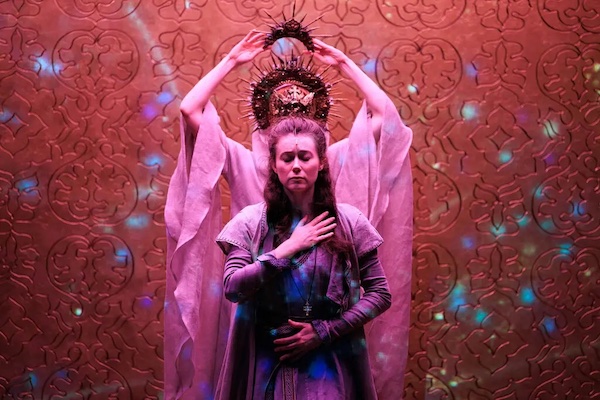
Snider’s eloquent libretto (with dialogue in English and prayers in Church Latin) reimagines and mushrooms documented elements of the mystic’s life into a story that addresses, without didacticism, the Church’s historical oppression and sidelining of women. Whirling, hypnotic projections convey the surreal visions that both plagued and motivated the Benedictine nun in the monastery of Disibodenberg in Germany. A room-sized cube glides to different parts of the stage for different scenes, often pushed by mystical crow-headed beings. It constitutes most of the set, used evocatively to represent a chapel, the abbey’s scriptorium, and whatever other enclosure is needed.
Soprano Nola Richardson reveals polished acting skills that effectively complement the silvery glow of her voice. Richardson proves herself not only the wonderful singer she has always been but a true operatic leading lady.
That’s not to say a diva, as hers is the type of warm stage charisma that carries us into the world of her character rather than grabbing us by the face. In a scene that exemplifies this quality, Hildegard re-enacts her initial “enclosure” in the abbey as a girl, dramatically depicted as a kind of burial alive.
She takes with her into this re-enactment a younger nun, the newly arrived Richardis von Stade, whom she has taken under her wing. Mikaela Bennett plays Richardis, a fellow nun who in real life functioned as an advisor and secretary to Hildegard. The visionary said of Richardis that she “cherished [her] with divine love.” Snider’s libretto makes Richardis a touchpoint for Hildegard’s experience of earthly love. In the opera, Richardis has fled beatings and abuse meant to “treat” her epilepsy at another abbey. Nursing her back to health, Hildegard discerns Richardis’s artistic talent and recruits her to illustrate her visions. But their relationship ultimately steers the story toward sadness, if not tragedy.
Bennett’s darker, throatier voice with its volcanic low end contrasts with Richardson’s and in this context distinguishes Richardis as a woman of earthbound passion. The differences make their duet scenes all the more striking. Bennett’s rich tone also deepens our sympathy when, for example, she expresses insecurity about her worthiness to be part of Hildegard’s vision project, or when her wealthy mother comes to bring her back to the abusive abbey and Richardis objects that at Disibodenberg, at last “I feel like I belong on this Earth.”
Baritone David Adam Moore’s strong, clear voice and sometimes humorous characterization makes the oppositional if not quite villainous Abbott Cuno stand out. Tenor Roy Hage is tangily affecting as Hildegard’s friend Brother Volmar, even if his sympathy for and acceptance of his friend’s same-sex desires seems a bit unrealistic for the time.
Although already the magistra (head) of her community of nuns, Hildegard von Bingen wanted more independence, and asked her abbott to sanction her opening of an independent monastery for nuns. That’s just one of the opera’s story elements that revolve around Hildegard’s challenging of authority, either the Church’s or that of her own conscience or prejudices. She thus becomes, in this telling, more fully a proto-feminist.
But Hildegard isn’t primarily a “message” show. Elkhanah Pulitzer’s direction and the contributions of an outstanding creative team add up to a spectacular production. On the wings of Snider’s gorgeous music, it’s one of the most enthralling theatrical experiences I can remember.
Hildegard‘s New York premiere continues through January 14 as part of the Prototype Festival, which continues through January 18.