 Blogcritics The critical lens on today's culture & entertainment

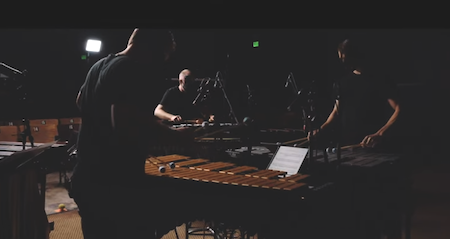
Percussion music can sound dry and detached. Most of the music on Patterns & Form, out now from Portland Percussion Group, is anything but. Vibrantly rhythmic and restlessly melodic, the three movements of the title piece by Alejandro Viñao brim with warm-blooded energy. “The Spaces Between” by Mendel Lee starts with textural ambient music and finishes with cool, shiny bell pulses. Structurally and timbrally more typical of percussion-ensemble repertoire, the appealing “Whatever was lost never thenceforth mattered” by Daniel Webbon is an exercise in randomness-over-regularity.
A ‘Tubular Bells’ for the 21st Century?
Pianist Yoko Greeney joins the members of Portland Percussion Group for Viñao’s opus. The piano is an instrument of multiple natures, and it’s the percussive aspect that the composer stresses here. While prominent in the mix, the piano might just as well be a xylophone or another traditional tonal percussion instrument.
The first movement, “The Fabric of Pulse (La Trama del Pulso),” maintains a constant staccato rhythm while the timbres and tones and melodic fragments shrink, blossom, and evolve continuously. This exciting and vibrant music shows kinship with certain types of progressive rock as well as classic instrumentals like “Tubular Bells.”

Following traditional classical-music form, the second movement is slower, even meditative. It has a similar constant motion, but in rhythms that keeps changing as they support melodies of correspondingly varying character. At the end the sonic landscape shifts to an underwater feel, with chimes and wandering piano notes subsiding into oblivion.
The final movement begins with quietly echoing bells, then rapidly expands into a muscular rhythmic soundscape, still with keen focus on tonal percussion. From there the energy ebbs and flows, time signatures are established and broken, pace quickens and slows, transitions become more dramatic.
Patterns & Form, especially its scintillating first movement, could actually have popular appeal. (Or am I just stuck in the 1970s?)

Spaces that Matter
The first section of Mendel Lee’s aptly titled “The Spaces Between” has a liminal quality, a sense of preparation and potential. What sounds like a quietly tinkling bell beats irregular time over amorphous tonal vibrations from marimbas in a short introductory section. The same instrumentation starts off the second section with a suggestion of Debussy’s “Clair de Lune.”
A moody third mini-movement features marimba in stop-start rhythms as a quiet whistling slowly lowers in pitch, followed by a series of high sighs that increase in volume as if from a backwards recording but achieved by bowing the keys. A bit surprisingly, all the sounds come from mallet strikes on keys. It would not be a stretch to slot the whole nine-minute piece into the category of ambient music, the kind that repays a close listen.
A steady ticking accompanies a drum kit solo and what sound like wood blocks to open “Whatever was lost never thenceforth mattered” by Texas drummer and composer Daniel Webbon. A second section has something reminiscent of a door chime softly ding-donging as the drums continue to play what feel like improvised figures. The playing grows more insistent and a sense of planned chaos grows as the chiming expands in complexity.
This piece too holds to a fast-slow-fast structure, but always dominated by the drums, which convey a sense of struggle. Webbon’s inspiration was a horrific tale by David Foster Wallace, and while the music is abstract, it suggests fear and perhaps violence itself.
The piece clocks in at under six minutes, which is plenty long for a drum solo, and just the right length for this time-bound, wordlessly disturbing abstraction.
Patterns & Form from Portland Percussion Group is out now on New Focus Recordings and available at Bandcamp.