 Blogcritics The critical lens on today's culture & entertainment

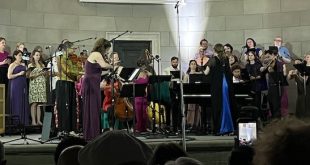
A classical-music supergroup? The Principal Brothers are just that: four Black principal (first-chair) woodwind players, who joined forces for a chamber concert in New York City. This magical evening, part of the People’s Symphony Concerts series, featured music by Bach, Villa-Lobos, and contemporary composers Valerie Coleman and Errollyn Wallen, plus solo works written for each of the four players by James Lee III.
“Principal” or first-chair refers to the lead player on his instrument in a symphony orchestra. My readers (and New York concertgoers in general) might be familiar with Anthony McGill, principal clarinetist of the New York Philharmonic. Anthony’s (actual) brother Demarre McGill has been principal flutist at no fewer than five orchestras and currently holds the chair at the Seattle Symphony. Together with “brothers” Titus Underwood, principal oboe of the Nashville Symphony Orchestra, and Bryan Young, principal bassoon of the Baltimore Chamber Orchestra, they appeared not just as Principal Brothers but performing music by James Lee III written for them titled Principal Brothers.
Principal Brothers: The Musicians and the Music
The piece consists of four brief and thematically related solo three-movement works – one could think of them as sonatinas – one for each of the instruments. The composition originated during the pandemic lockdown, when Lee offered it to the living-room-bound musicians. The concert opened, however, with the chorale prelude “Ich Ruf’ Zu Dir, Herr Jesu Christ” by J.S. Bach, beautifully played by the quartet. The performance was so exquisite it felt as if this was the only possible instrumentation for this beautiful piece. More than that, it sounded as if Bach were speaking directly to us through the reeds and embouchures of these fine musicians.
“Principal Brothers No. 1” for solo flute followed, after which the program continued alternating between ensemble works and the Lee solo pieces. Lee has close connections with the “Brothers.” He has served as composer-in-residence with the Baltimore Symphony where Young holds the principal bassoonist chair, and Anthony McGill has performed numerous works by Lee including the premiere of Lee’s Clarinet Concerto. The solo pieces indeed seemed to highlight the musicians’ own distinctive voices. They worked nicely as “interval” music but also as showpieces for the soloists’ virtuosity and deep musicality.
There was something Nordic about the looping melody of the lovely first movement of the flute “sonatina,” and something gently spiritual about the whole piece. The next movement began in darkness before developing into an active exploration of what felt like an interior landscape we were privileged to view. The last movement combined a fluttering dance feel with rhythms that suggested folk and rock. A sudden vaulting key change brought it to a close, forming a nice setup for Heitor Villa-Lobos’ 1928 Quartet for Flute, Oboe, Clarinet and Bassoon.
The “Allegro non troppo” proceeded with sparkle and verve, bathed in unsettling and intriguing harmonies, rhythmic shifts, counterpoint, and humor, with melody tossed from musician to musician as if they were throwing a ball around. The dimensionality of the music came through remarkably, thanks also to the acoustics of the High School of Fashion Industries auditorium, which proved optimal for this strain of chamber music. A beautifully balanced, richly colored performance of the second movement suggested watery waves streaked with sunshine. Though marked “Lento” it moved along quite actively, leading to the impish finale with its flung-around scales calling back to the first movement.
Virtuoso Brothers
“Principal Brothers No. 2” for oboe began with a haunting, snaky melody, dynamically varied as it twisted to a conclusion. The second movement had the spirit of a love song, though without resolution, and the speedy and very brief finale found Underwood careening all over the range of the instrument.
After an intermission the solos resumed with “Principal Brothers No. 3” for clarinet. It called for the soloist to echo little gestures from one octave to another to another, reminding me of the kind of writing you more often hear for a virtuosic violinist. The second movement featured some impossible-sounding leaps, and it finished with a quick, squirrelly finale.
Rubispheres for flute, clarinet and bassoon comes from Valerie Coleman, a composer not unfamiliar with wind instruments. This for me was the highlight of the program’s contemporary-music choices. A bassoon intro and unison melody develop into surprising harmonic movement, followed by music that suggests a spy-show theme with obbligato from the bassoon and virtuosic flights from all three instruments. A placid, pastoral slow movement with folk-song-like intervals prepared the way for a spectacular performance of a rhythmically tricky final movement laced with exquisite writing and active, bebop-like melodies over a relentless beat – with flashes of the blues. Quite something!
“Principal Brothers No. 4” for bassoon moved from a loping first movement through a lyrical second to an airy, jazzy finale. The concert ended with a new work by Errollyn Wallen, Everything Is Curved, which reflected back on the Bach chorale in several ways. The first was a chorale-like introductory section using a modernist vocabulary. After an exciting scherzo-like movement full of syncopations and sudden accents, a very Bachian air transitioned into a segment that charged into a 20th-century mode. Pretty passages of rolling accompaniment under subtle oboe melodies led to a final section that was again chorale-like.
It’s a platitude to say that a concert was a “special evening,” but this one truly was.
Find out about upcoming People’s Symphony Concerts at their website.