 Blogcritics The critical lens on today's culture & entertainment

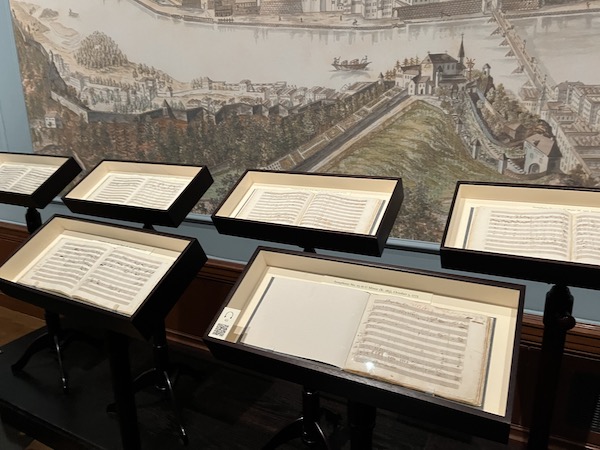
There’s a wonderful Mozart exhibit right now at the Morgan Library and Museum in New York City. Full of manuscripts, artwork, letters, ephemera, even Mozart’s childhood violin, it displays many treasures on loan from the Mozarteum Foundation in the composer’s birthplace, Salzburg, Austria. For anyone interested in classical music who can get there, it’s a can’t-miss. More than any prose biography, these inanimate, silent objects convey a sense of what the man was actually like and why his music has remained unfailingly popular for centuries.
The mature Mozart, his gifts fully developed, could imbue his music with both youthful mirth and angelic ease. Such is the case with Quartet for Flute, Violin, Viola and Cello in A major, K. 298. It opened the final concert of the 2025–26 Chamber Music Society of Lincoln Center series at the intimate Rose Studio. The Mozart was a smiling start to an interesting and high-energy program.
Here Mozart didn’t make the flute the star of the show, as in a sonata or concerto. Essentially it replaces the first violin. The first movement, a set of variations, features the flute but also the violin, viola and cello in successive variations. Violist Matthew Lipman produced a particularly expressive tone. The cello-flute counterpoint passages sang (Inbal Segev and Sooyun Kim respectively). After the jolly Menuetto, each instrument again got a segment of the spotlight in the final Rondo.
Night Music from Arthur Foote
The rest of the program surged into less-familiar territory, first with the 1918 Nocturne and Scherzo for Flute and String Quartet by American composer Arthur Foote. Foote forged a distinct path in his time. He skipped European training to craft a noticeably American take on the various classical and romantic traditions.
Inspired by a Wordsworth poem, the Nocturne is richly pastoral, in a chromatic and harmonically adventurous way. Foote tightly integrates the flute, such that one can almost forget its parts aren’t those of just another violin – an effect realized neatly by Kim, Lipman, violinists Sean Lee and Lun Li, and cellist Jonathan Swensen. A second theme in 5/4 time grabs attention, then softens into a gently swaying 6/4 rhythm. An almost Beethovenian fury erupts in the middle, reflecting the composer’s affinity for German romanticism while showing a different kind of compositional muscle.
The Scherzo has a driving force, with a dark trio section. At moments, to me, its sound looked forward to Copland. This convincing performance made me wonder why Foote’s chamber music isn’t more often performed.

The Sextet in G minor for Strings, Op. 178 of Joachim Raff is a 19th-century rave, with four movements of nearly nonstop action. A melodramatic “Allegro” in a grinding triplet beat; a racing, perpetual-motion “Allegro molto” that enfolds a lyrical trio section but otherwise threatens to plunge into chaos; a “Larghetto” that starts like a lullaby but quickly grows more complex, and grimmer; and a fiery closing “Allegro” comprise a half-hour of turbocharged rhythm-making.
The piece received a bravura performance, and was almost exhausting to experience. It was surely a challenge to play. Violist and host Thompson noted that a sign of an intense piece of chamber music is when the viola parts – the middle voices – play in every single bar.
Dating from 1872, this work was of its time harmonically but defied other standards of construction. Kudos to these musicians and the Chamber Music Society for dusting off this extraordinary creation and giving it a fair and muscular airing before an appreciative audience.
While the Raff’s energy was overwhelming, in a purely musical sense the Foote piece was the centerpiece and highlight of the evening.
As for the Mozart, it’s hard to go wrong. Just ask any of his contemporaries, colleagues, patrons, family members and loved ones – and the history as a whole – whose testimony is all over the exhibit at the Morgan Library.